British Airways Birmingham Liveried Aircraft (Image Credit: British Airways)
This article was published in 2019 in a series on the history of British Airways and its predecessors Imperial Airways, BOAC and BEA. You can browse all 100 stories in number order, by themeor by decade.
Many have been updated since first published.
In its near 100 year history, the operations of BA and its predecessor airlines have been primarily based in London.
However, all of BA’s predecessor airlines have a history with the UK regions. Imperial Airways began operating a route from London to Birmingham and Manchester in the early 1930s.
British European Airways, Manchester Airport, Date Unknown (Image Credit: Manchester Airport)British European Airways & British Overseas Airways Corporation aircraft at Manchester Airport, circa 1970s (Image Credit: Manchester Airport)British Airways Boeing 747 aircraft at Manchester Airport, Date unknown (Image Credit: Manchester Airport)
The relationship between BA and UK regions over the past few decades could be described as “somewhat difficult”.
“Manchester Terminal 1 British Airways”
30 years ago, BA had a substantial presence in the UK regions.
It had a sizeable long-haul route network in Manchester serving Barbados, Hong Kong, Islamabad, Mumbai, New York, Orlando, as well as around 10 UK domestic airports and 18 airports in mainland Europe.
Manchester airport also opened a new £75m terminal called “Terminal 1 British Airways” to house all BA services under one roof and offering a minimum connection time of 30 minutes for transfer passengers.
BA also had a sizeable presence in Birmingham dubbed a “Eurohub” from 1991, with the airport also being the first to receive new deliveries of Airbus A319 aircraft in 1999.
BA also used to operate transatlantic routes to New York from Birmingham and Glasgow until 1999. Other airports such as Bristol and Southampton also had a BA presence.
The short-haul operation across the UK was a mix of acquired airlines and franchise partners with a varied fleet that was in near permanent state of restructuring. In its last years, this was known as “BA Connect”.
BA Connect Embraer E145 Aircraft G-EMBB (Image Credit: British Airways)
Over time, BA gradually reduced its presence following the rise of low cost airlines. Cabin crew bases in Glasgow and Manchester were closed. Ground staff at UK regional airports were outsourced. Links from Gatwick to Aberdeen, Manchester and Newcastle were cut as part of a “de-hubbing” of Gatwick.
This article was published in 2019 in a series on the history of British Airways and its predecessors Imperial Airways, BOAC and BEA. You can browse all 100 stories in number order, by themeor by decade.
Many have been updated since first published.
Even over the past two decades, air travel has changed beyond recognition.
Whether it is due to advances in technology, security requirements, changing social attitudes or simply cold hard economics, there have been any facilities and services withdrawn over the past few decades.
1. Peruse a printed timetable
Sadly, these were withdrawn many years ago. Of course, you now have searchable timetables online, but sometimes it is easier to just browse the printed page. Printed timetables do of course also serve as a permanent historical record. Here’s one of, if not the last, printed timetables from 2007/2008.
2. Rock-up at the gate without a ticket 10 minutes before your flight
It’s unthinkable today, but in the era of BA’s Shuttle Service on UK domestic routes you could just turn up at the gate 10 minutes before departure without even a ticket and be guaranteed a seat on the aircraft
3. Check-in downtown
It wasn’t until that long ago you could check-in for your flight (and in some cases luggage) at Paddington and Victoria stations.
BA also used to offer Club Europe passengers the ability to check-in at parking and car hire facilities. At some airports you could also check-in in the lounge or at the departure gate.
4. Check-in by telephone
No, not on your phone. But as in literally calling up BA.
5. Make a run for your flight
Running late for your flight? Caught up in traffic or just missed a Heathrow Express train? Hoping to make a run for the departure gate and catch the flight just as the aircraft doors are closing?
Today, not a chance, at least at Heathrow Terminal 5. The opening of Terminal 5 introduced the concept of “conformance” whereby you have to clear security 35 minutes before your flight departs or you will be automatically offloaded from the flight.
Although many passengers viewed this as an aberration and BA admitted at the time it would require giving passengers difficult messages, it has been maintained.
This article was published in 2019 in a series on the history of British Airways and its predecessors Imperial Airways, BOAC and BEA. You can browse all 100 stories in number order, by themeor by decade.
Many have been updated since first published.
Rosalind “Roz” Hanby was the face of British Airways through much of the 1970s and early 1980s.
Roz joined BOAC as cabin crew in the early 1970s and worked for BOAC and BA on the Boeing 707 and VC10 aircraft, as well as Concorde, before taking up a full time role promoting BA.
Roz appeared in numerous print and TV advertisements all over the world, including a BA billboard that featured in the James Bond film “Moonraker”. Roz left BA permanently in 1982 to pursue a career in television.
Roz Hanby spoke to advertising industry publication “Campaign” about her time at BA as part of its 50th birthday celebrations in 2018:
You can continue reading our 100 part series on the history of British Airways and its predecessor airlines Imperial Airways, BOAC and BEA in numerical order,by theme or by decade.
If you would like to receive all future articles published by London Air Travel directly by e-mail, then enter your e-mail address below:
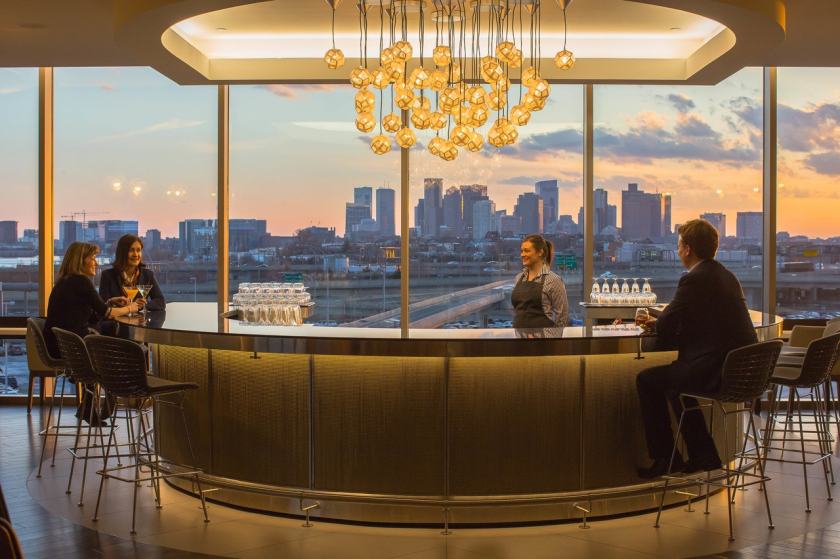
British Airways Lounge, Boston Logan International Airport (Image Credit: British Airways)
This article was published in 2019 in a series on the history of British Airways and its predecessors Imperial Airways, BOAC and BEA. You can browse all 100 stories in number order, by themeor by decade.
Many have been updated since first published.
For many passengers, the lounge before a flight is considered an essential part of the travel experience.
High quality decor, furnishings from leading designers, complimentary food and beverage, and often some very interesting people watching all help provide a welcome respite from the departure terminal.
There are many lounges in the world, such as the Qantas First Class lounges in Sydney, that are rightfully known as destinations in their own right.
BA does of course have lounge complexes at London Gatwick, Heathrow and New York JFK, as well as many lounges around the world.
When BA introduced the Shuttle Service on UK domestic routes in 1975, it added a dedicated lounge by the gate area.
A dedicated lounge was also added for Concorde passengers at Heathrow Terminal 3, ahead of the introduction of supersonic flights to Bahrain in 1976. This would become known as the Concorde Room.
However, it was in the 1990s that saw the start of real innovations.
BA introduced new lounge pavilions at Heathrow Terminals 1 and 4 and the Gatwick North Terminal.
In 1993, BA introduced its first arrivals lounges at London Gatwick & Heathrow. Whilst these were much valued by passengers arriving early in the morning, there are remarkably few arrivals lounges outside of Heathrow.
As part of a focus on the ground experience for Club Europe passengers travelling for business in the mid-1990s, BA added a number lounges in Europe. Many such as Copenhagen, Dusseldorf and Munich have since closed.
As BA developed a very close working relationship with Qantas in the mid-1990s, it opened a number of joint lounges in Asia, including Bangkok, Hong Kong, Kuala Lumpur, Manila and Singapore. As BA and Qantas have since gone their separate ways, they no longer share lounges.
The Terraces Lounge Concept
Towards the late 1990s, BA introduced the Terraces concept for its business class lounges worldwide.
The idea behind these lounges was a number of designated zones that passengers could choose to use according to their needs such as the Larder, World Wine Bar, Combiz Centre and the Sanctuary.
Lounges also included garden furniture, water features and piped bird song with the aim of creating an open an airy feel “to bring the outside in”, to the extent this can be achieved inside an airport terminal building. Although this format is now redundant you’ll still see traces of it at many airports.
BA also recruited Sir Terence Conran to design new Concorde rooms for passengers at London Heathrow Terminal 4 and New York JFK. These lounges featured many 20th century design classics such as Hoffmann Villa Gallia sofas, Eileen Grey Bibendum, Matthew Hilton Orwell and Balzac chairs and the Charles & Ray Eames lounge chair and office chair.
In 2001, BA also opened its Molton Brown Travel Spa (now operated by Elemis) at London Heathrow. As BA introduced its Club World “Sleeper Service”, pre-flight dining facilities were added to many US East Coast lounges.
First Class passengers and Executive Club Gold cardholders benefited from separate FIRST lounges.
The “Galleries” Lounge Concept
British Airways Galleries First Lounge, London Heathrow Terminal 5 (Image Credit: British Airways)
Ahead of BA’s move to Terminal 5 in 2008 came the “Galleries” concept. It made its debut in Brussels and Philadelphia.
The opening of Terminal 5 saw the introduction of a 8 new Galleries lounges across Terminals 3 and 5.
The lounges feature bespoke patterns designed by Osborne & Little and Swarovskichandeliers. BA also worked with Artwise to introduce many bespoke art works including Troika’s “Cloud” mechanical installation and “All The Time In The World” digital clock. Sadly, neither of these two installations are currently operational.
British Airways, “The World’s Favourite Airline”, 1983.
This article was published in 2019 in a series on the history of British Airways and its predecessors Imperial Airways, BOAC and BEA. You can browse all 100 stories in number order, by themeor by decade.
Many have been updated since first published.
There are now very many destinations in the world no longer served BA.
Some route suspensions were prompted by economic events such as the Asian financial crisis in the late 1990s. Geopolitical events and security concerns have also caused a number of suspensions, notably Baghdad and Basra.
Many former routes were 1/2/3 stop flights which are now more economically served by connections to alliance and codeshare partners. BA also suspended a very large number of former BMED/bmi routes after its acquisition in 2012.
COVID-19, which saw the abrupt retirement of BA’s Boeing 747 fleet, resulted in many long-haul routes formerly operated by the Boeing 787 aircraft suspended.
Medium and long-haul routes and airports formerly served by BA, excluding franchises and subsidiaries, since its formation in 1974 include (minus a few omissions no doubt!):
North America
Canada
Calgary – This route launched in December 2006, initially with a Boeing 767 aircraft. It became a summer seasonal only route in 2019. It did not resume in 2020 due to COVID-19 and the route was since suspended.
Edmonton – Suspended by BA in 1982.
Montréal Mirabel – Flights transferred to Montréal Trudeau International.
United States Of America
Anchorage – BOAC and BA used to fly to Tokyo via Anchorage:
Charleston – This launched as a twice weekly summer seasonal route from 4 April to 24 October 2019. It did not return in 2020 due to COVID-19 and was since suspended permanently. The flight numbers were BA221 & BA220.
Charlotte – Launched in January 1994, operated from Gatwick using a USAir Boeing 767 in BA livery and operated by USAir crews in BA uniforms.
Detroit – This route was suspended on 30 March 2008.
Fort Lauderdale – This route operated from Gatwick between 6 July 2017 and 7 September 2019.
Oakland – This route operated from Gatwick between 28 March 2017 and 13 October 2018.
Pittsburgh – BA first flew from London Heathrow to Pittsburgh via Washington from May 1986 to June 1993. It was then operated from Gatwick until October 1999 using a US Air Boeing 767 aircraft and crew in BA colours. It was launched as a non-stop route on 2 April 2019. It was suspended following COVID-19. The last flight to London Heathrow operated on 15 March 2020. The flight numbers were BA171 & BA170. It is now due to relaunch in June 2022.
Portland – This route was due to launch on 1 June 2020. It is now due to launch in June 2022.
Puerto Rico
San Juan
Central & South America
Columbia
Bogota
CUBA
Havana
Venezuela
Caracas
Peru
Lima – This route launched from Gatwick on 4 May 2016. It became a summer seasonal route from 2017. It did not operate in 2020 due to COVID-19 and is now suspended.
Africa
Angola
Luanda – This route was suspended on 9 June 2018. The former flight numbers were BA77 & BA76.
Botswana
Gaborone
Cameroon
Douala
Côte d’Ivoire
Abidjan
Democratic republic of the congo
Kinshasa
Egypt
Luxor
Ethiopia
Addis Ababa – This route was inherited from bmi and suspended on 10 June 2012.
Gambia
Banjul
Liberia
Monrovia – This route was suspended on 6 August 2014.
Libya
Tripoli – This route was suspended in July 2014.
Malawi
Lilongwe
Morocco
Agadir – This route was inherited from bmi suspended on 26 October 2014.
Casablanca – This route was inherited from bmi and suspended on 28 October 2012.
Sierra Leone
Freetown – This route was inherited from bmi and suspended on 6 August 2014.
South Africa
Durban – This launched as a non-stop route from London Heathrow on 29 October 2018. It was suspended following COVID-19 with the last flight to Heathrow operated on 26 March 2020. The former flight numbers were BA41 & BA40.
Sudan
Khartoum – This route was inherited from bmi and suspended on 1 October 2012.
Tanzania
Dar es Salaam – This route was suspended in 2012.
Uganda
Entebbe – This route was suspended on 3 October 2015. The former flight numbers were BA63 & BA62.
Zambia
Lusaka – This route was suspended on 26 October 2013. The former flight numbers were BA254 & BA255.
Zimbabwe
Harare – This route was suspended on 28 October 2007, in part due to increased operating costs as aircraft fuel had to be trucked from South Africa.
Indian Ocean
The Seychelles – BA returned to The Seychelles with a twice weekly service on 24 March 2018. The route was suspended following COVID-19. The last flight to Heathrow operated on 4 January 2021. The former flight numbers were BA63 & BA62.
The Middle East
Iran
Tehran – This route was inherited from bmi and suspended on 12 October 2012. BA returned to Tehran on 1 September 2016. The route was suspended again from Sunday 23 September 2018. The former flight numbers were BA152 & BA153.
Iraq
Imperial Airways began flights to Basra in 1927 and to Baghdad in 1929. Flights were suspended in March 1987 during the Iran / Iraq war. Flights resumed again in November 1988 to be suspended again in February 1990 in the lead up to the first Gulf war.
Baghdad – Plans were announced in April 2003 to resume services when safe to do so, but these have never been realised.
Basra – BA was given permission to fly to Basra in August 2003. BA announced plans to fly twice weekly, via Kuwait, once it was safe to do so, but these have never been realised.
Lebanon
Beirut – This route was inherited from bmi. It was officially suspended from 11 May 2020. The last flight to Heathrow operated on 16 March 2020. The flight numbers were BA148 and BA149.
OMAN
Muscat – This route was suspended following COVID-19. The last flight to Heathrow operated on 22 March 2020. The flight numbers were BA79 and BA80.
Saudia Arabia
Dhahran
Dammam – This route was inherited from bmi and suspended on 16 September 2012. BA returned to Dammam as an extension of its service to Bahrain from 1 December 2019. This was since suspended due to COVID-19. The last flight to Heathrow via Bahrain operated on 14 March 2020.
Jeddah – This route, along with Riyadh, resumed 29 March 2009 after BA suspended all services to Saudi Arabia in March 2005. It was suspended again following COVID-19. The last flight to Heathrow operated on 14 March 2020. The former flight numbers were BA132 & BA133.
Syria
Damascus – This route was inherited from bmi and suspended on 29 May 20212.
YEMEN
Amen – Suspended in May 1994
Sana’a – Suspended in May 1994
South & Central Asia
Armena
Yerevan – This route was inherited from bmi and suspended on 13 October 2012.
Azerbaijan
Baku – This route was inherited from bmi and suspended on 29 April 2016.
Bangladesh
Dhaka – This route was suspended on 29 March 2009. The former flight numbers were BA145 & BA144.
Georgia
Tbilisi – This route was inherited from bmi and suspended on 31 March 2013.
India
Amritsar – This route was inherited from bmi and suspended on 28 October 2012.
Kolkatta – This route was suspended on 29 March 2009.
Kazakhstan
Almaty – This route was inherited from bmi and suspended on 12 October 2015. The former flight numbers were BA158 & BA159.
Kyrgyzstan
Bishkek – This route was inherited from bmi and suspended on 1 October 2012.
Pakistan
Karachi
Sri Lanka
Columbo – This route operated as an extension of BA’s service from Gatwick to The Maldives and was suspended from 28 March 2015.
The Far East
Greater China
Beijing Capital International – Flights transferred to Beijing Daxing International on Sunday 27 October 2019.
Chengdu – This route launched in September 2013. It was suspended in January 2017 due to poor commercial performance. The last flight to Heathrow operated on 13 January 2017. The flight numbers were BA88 & BA89.
Hong Kong Kai Tak – Flights transferred to Hong Kong International in 1998.
Indonesia
Jakarta – Route suspended circa 1999/2000.
Japan
Fukuoka – Launched July 1991
Nagoya – Launched April 1992
Osaka – This route was previously operated via Tokyo Narita until October 1998. It was reinstated as a non-stop route on 31 March 2019. It was suspended following COVID-19. The last flight to Heathrow operated on 28 March 2020. Occasional cargo only flights have operated since. The former flight numbers were BA19 & BA20.
Tokyo Narita – BA officially consolidated flights to Tokyo at Tokyo Haneda airport from Saturday 28 March 2020. However, a number of cargo only flights to Tokyo Narita operated since.
Malaysia
Kuala Lumpur – BA returned to Kuala Lumpur on 27 May 2015 after the route was suspended in 2001. The route was suspended following COVID-19. However, a number of cargo only flights have continued to operate. The former flight numbers were BA33 & BA34.
The Philippines
Manila – This route, which operated via Hong Kong, was suspended in December 2001.
South Korea
Seoul – BA returned to Seoul in December 2012. The route was suspended following COVID-19. A number of cargo only flights have continued to operate. The former flight numbers were BA17 & BA18.
Taiwan
Taipei – This route, which operated via Hong Kong by British Asia Airways, was suspended in December 2001.
Pacific
Australia
Adelaide – Suspended March 1996
Brisbane – The route, which operated via Singapore, was suspended around 2000/2001, with the Singapore – Brisbane leg handed over to BA’s then joint venture partner Qantas.
Melbourne – The route, which operated via Singapore, was reinstated around 2000/2001 and then suspended again from 25 March 2006.
Perth – The route, which operated via Singapore, was suspended around 2000/2001, with the Singapore – Perth leg handed over to BA’s then joint venture partner Qantas.
New Zealand
Auckland – Suspended March 1996 Christchurch – Suspended circa 1989/1990
Short-haul routes and airports previously served by BA include Almeria, Bastia, Berlin Tegel, Bergen, Bremen, Cork, Dresden, Helsinki, Kyiv, Leeds Bradford, Leipzig, Limoges, Malmo, Milan Bergamo, Montpellier, Moscow Sheremetyevo, Murcia, Nantes, Nuremberg, Paris Orly, Plymouth, Sarajevo, Shannon, Stavanger, Tallinn, Trieste, Varna and Vilnius.
You can continue reading our 100 part series on the history of British Airways and its predecessor airlines Imperial Airways, BOAC and BEA in numerical order,by theme or by decade.
If you would like to receive all future articles published by London Air Travel directly by e-mail, then enter your e-mail address below:
This article was published in 2019 in a series on the history of British Airways and its predecessors Imperial Airways, BOAC and BEA. You can browse all 100 stories in number order, by themeor by decade.
Many have been updated since first published.
In 100 years, relationships between BA and other airlines have come and gone.
Whether it’s a simple codeshare with Emirates or an equity stake in Qantas, for one reason or another, both sides have moved on.
If there’s one airline in the world that BA should have got together with, but didn’t, it was KLM. This was not for a lack of trying. BA and KLM held merger talks in 1992 and 2000 and both fell through.
BA and KLM also held talks in the late 1980s in each buying a stake in a new subsidiary of Sabena in Belgium, Sabena World Airways, to create a new hub in Brussels. This fell through because of the poor financial health of Sabena.
On the second merger attempt the main issues were control and anti-trust immunity. KLM benefited from anti-trust immunity with Northwest Airlines which required the airline to be majority-controlled by Dutch nationals. BA insisted on having full control of the combined airline. This would have required KLM to a subsidiary of a combined BA-KLM controlled by BA. KLM baulked at the idea.
The attractions were obvious. Amsterdam Schiphol airport, with its four runways, is in close proximity to the UK. KLM serves very many UK regional airports that BA doesn’t. It also has a much broader route network. Joint marketing of flights via hubs in Amsterdam and London would have provided a strong proposition for all UK flyers, not just those in London.
This article was published in 2019 in a series on the history of British Airways and its predecessors Imperial Airways, BOAC and BEA. You can browse all 100 stories in number order, by themeor by decade.
Many have been updated since first published.
In December 2019, British Airways will celebrate 90 years of flying to India, an extremely important market for the airline.
The First Flights To India
BA traces its first flight operations to India to 1924. On 10 November 1924, a test flight journey, by DeHavilland DH50 biplane, took four months to complete a round trip.
The flight made 27 stops as it flew via Paris, Cologne, Berlin, Warsaw, Lublin, Lemberg, Ploesti, Bucharest, Constantinople, Konia, Aleppo, Rakka, Ramadi, Hinaidi, Shaibah, Bushire, Bandar Abbas, Chahbar, Karachi, Jodhpur, Nazirabad, Delhi, Allahabad, Calcutta, Chittagong and Akyab to Rangoon.
The first through passenger flight from London to India was operated on 30 March 1929. It took nearly seven days to complete. The initial routing, by four different means, was as follows:
London Croydon – Paris – Basle by Armstrong Whitworth Argosy aircraft.
Basle – Genoa by train (Italian authorities refused to permit British aircraft to enter Italy via France.)
Genoa – Rome – Naples – Corfu – Athens – Suda Bay (Crete) – Tobruk – Alexandria by Short Calcutta flying boat.
By the late 1930s, flight times had been progressively reduced and India could typically be reached in two and a half days on Imperial Airways’ flying boats. Today, flights take approximately ten hours non-stop.
The market has historically been restricted by limitations of flights under a bilateral treaty between the UK and India. This was relaxed in 2005 and enabled BA to increase flights from London Heathrow from 19 to 35 a week. BA launched a new five times weekly service to Bengaluru and increased frequencies on other routes.
BA did also seek to set-up a local franchise partner India, where there had been considerable restrictions on foreign ownership of airlines, but to no avail. A new service to Hyderabad was added in 2009.
The relaxation of the bilateral treaty also prompted a number of new entrants into the market, notably bmi British Midland, which was suspended Mumbai shortly after launch. Virgin Atlantic launched a new service to Mumbai which it has now suspended & relaunched twice.
Today BA flies to five cities: Bengaluru, Chennai, Hyderabad, Mumbai, and New Delhi. It has previously suspended non-stop flights to Amritsar (briefly inherited from bmi) and Kolkata. BA also has cabin crew bases in India who also wear a dedicated uniform.
India is a competitive market and expectations of local passengers are very high. It has proved difficult for privately owned airlines in India. Former Oneworld alliance member Kingfisher Airlines collapsed in 2012. Jet Airways collapsed earlier this year. Whilst they were not financially successful, they provided strong competition on in-flight service. Emirates also provides strong competition, particularly for connecting traffic between the US and India.
BA has used emotional appeal to promote itself in India with a strong emphasis on family bonds, as per these five films from 2013 to 2016:
This article was published in 2019 in a series on the history of British Airways and its predecessors Imperial Airways, BOAC and BEA. You can browse all 100 stories in number order, by themeor by decade.
Many have been updated since first published.
Before airports had direct public transport links, airlines used to provide centrally located air terminals where passengers could check-in their luggage and then be bussed passengers to the airport.
The first British European Airways terminal was Kensington Air Station which opened in 1948. Prior to that BEA used BOAC’s Victoria Air Terminal to transport passengers to Northolt.
The Waterloo Air Terminal
BEA London Waterloo Air Terminal 1956
BEA opened the Waterloo Air Terminal on 19 May 1953.
It was located at 18 York Road on the South Bank of the Thames, facing London Waterloo railway station. The structure had originally been constructed for the 1951 Festival of Britain celebration and was intended to be a temporary location.
The terminal was also used by Aer Lingus, Air France, Iceland Airways, Sabena, SAS and Swissair. It was designed to handle 60 flights an hour and 16,000 passengers a day. There were also ambitions to add a helicopter station nearby. However, this did not come to fruition.
The terminal proved to have a very short life at it was demolished in 1957 to make way for the construction of new Shell Headquarters.
The West London Air Terminal
The first West London Air Terminal opened on Cromwell Road on 6 October 1957 as a temporary structure.
Its location was chosen because of its proximity to the Circle, District and Piccadilly Lines and the M4 motorway.
It was a relatively modest two storey structure. A new permanent structure, constructed at a cost of £5m, was officially opened by the Duke of Edinburgh on 6 November 1963.
It was an impressive structure both architecturally and for its on site facilities. Designed to handle 4.5m passengers a year, the construction was complicated by the fact that it was built 25ft below ground between branches of the Circle and District lines. It had to be constructed without disturbing the operation of London Underground during the day. Access roads had to be built out over the Tube lines on suspended concrete rafts.
The West London Air Terminal, Cromwell Road
The main concourse was located on the upper levels of the structure which was connected to an elevated roadway which could be reached by spiral ramps at either end of the building.
The aim was to provide passengers with all the facilities they would expect of an airport. It featured an expansive check-in area with 23 desks, a licensed snack-bar and restaurant, duty-free shops, banking facilities and a double height open plan departure lounge. The building also accommodated offices for BEA staff on its upper floors. It even had its own telephone exchange capable of handling 10,000 calls a day for BEA reservations staff.
BEA decided to end check-in facilities at the West London Air Terminal from 1974. This was prompted by the opening of London Heathrow Terminal 1 in 1969 and the planned extension of the Piccadilly Line to Heathrow. The terminal continued to serve as a coach station for Heathrow before closing in 1979.
BA sold the West London Air Terminal in the 1980s. A branch of Sainsbury’s supermarket was constructed on the site. It’s certainly not a building that will be remembered with affection for its architectural merit.
The concept of centrally located check-in facilities did live on as BA used to offer check-in desks at Paddington and Victoria stations. However, these were withdrawn. Whilst downtown check-in facilities are offered at airports such as Hong Kong, there are no such facilities in London.
You can continue reading our 100 part series on the history of British Airways and its predecessor airlines Imperial Airways, BOAC and BEA in numerical order,by theme or by decade.
If you would like to receive all future articles published by London Air Travel directly by e-mail, then enter your e-mail address below:
This article was published in 2019 in a series on the history of British Airways and its predecessors Imperial Airways, BOAC and BEA. You can browse all 100 stories in number order, by themeor by decade.
Many have been updated since first published.
The “Speedbird” logo designed for Imperial Airways by Theyre Lee-Elliott in 1932 is considered one of the most enduring examples of modern graphic design.
Based on a stylised motif of a bird in flight it was retained by Imperial Airways’ successor BOAC.
In spite of many changes to BOAC’s identity and its fleet over decades, the Speedbird remained a consistent part of its aircraft liveries and visual identity.
It also featured on the first British Airways Negus livery. However, it was replaced by the Speedwing when BA introduced the Landor livery in 1984.
You can still see the Speedbird logo on the platform of Hatton Cross London Underground station. Of course the Speedbird name is still used as the Air Traffic Control callsign for BA.
100 Years Of British Airways: A look at Bartle Bogle Hegarty’s work for BA after they prized the advertising account away from Maurice and Charles Saatchi in 2005.
“To Fly. To Serve. Today. Tomorrow.” (Bartle Bogle Hegarty for British Airways)
This article was published in 2019 in a series on the history of British Airways and its predecessors Imperial Airways, BOAC and BEA. You can browse all 100 stories in number order, by themeor by decade.
Many have been updated since first published.
There is no advertising agency / client relationship more talked about in the UK advertising industry than British Airways.
When BA tendered its advertising account in 2005 such was the interest bookies even ran odds on which agency was likely to secure the account.
Bartle Bogle Hegarty (BBH), founded by John Bartle, Nigel Bogle, and John Hegarty prized the account away from Maurice and Charles Saatchi.
Not that the Saatchi brothers let go of the account quietly. They reportedly revelled in industry gossip that BBH was initially having difficulty pleasing BA. Allegedly a letter was drafted headed “British Airways. Serves You Right.” with the text “Please feel free to use the strapline in your upcoming advertising. Alternatively, simply stick it to the wall and stare at it for the next few months/years.”
The BBH/BA client relationship ended in 2017 after 12 years. BBH which lives by the mantra “When the world zigs, Zag.” would say itself that the relationship was something of a rollercoaster, not least because it spanned the 2008 financial crisis. However, there was plenty of scope for creativity, notably the 2012 Olympics campaign.
Here’s a run through of some other notable work by BBH for BA:
“Clouds” (2006)
This was BBH’s first TV advertising campaign for BA.
You could say it was a very steady start. The advert featuring a cover of John Denver’s “Leaving On A Jet Plane” highlighting BA’s commitment to service at affordable prices. Some of the items featured such as complimentary short-haul catering are of course no longer offered by the airline.
“Upgrade to BA” (2007)
“Upgrade to British Airways” was the strapline BBH pitched to BA.
This film features a very familiar device in airline advertising, with BA cabin crew handing out in-flight amenities to members of the general public in the attractive surroundings of Circular Quay in Sydney, highlighting the thoughtful and friendly nature of its service.
“Opportunities” (2009)
BA was hit very hard by the global financial crisis of 2008.
The backbone of the airline’s financial health, long-haul business class traffic, fell away following the collapse of Lehman Brothers.
In 2009, BBH created eight TV advertisements for BA encouraging business travellers to fly by highlighting forthcoming events around the world. The above advert featured the imminent Mumbai Fashion Week. This has echos of BA’s 2002 “It’s Better To Be There” advertising campaign after the events of 11 September 2001, emphasising the importance of doing business face to face.