Airbus A321 XLR Aer Lingus Livery (Image Credit: Airbus)
Aer Lingus has tentatively secured regulatory approval from the US Department of Transportation to join the transatlantic joint business with, amongst others, American Airlines and British Airways.
This has taken considerably longer than expected to obtain. IAG bought Aer Lingus in 2015. It did not start the formal process to join the transatlantic joint business until late 2018, and tentative regulatory approval has only just been granted.
Both Delta and JetBlue made representations to the US Department of Transportation. The concern of both airlines is securing slots at London Heathrow. The Competition & Markets Authority is still reviewing the competitive impact of the transatlantic joint business in the UK, and has deferred its final conclusion until 2024. Regulatory approval has been granted on condition that members of the joint business continue to comply with slot remedies at London airports.
As a condition of regulatory approval, the joint business is also required to remove exclusivity clauses from the agreements between airlines. These require any participating airline to obtain pre-approval before codesharing with another airline in the area covered by the joint business.
Qantas De Havilland DH50 Aircraft (Image Credit: Qantas Airways)
Welcome to London Air Travel’s Monday Briefing for the week beginning 16 November 2020.
Qantas Celebrates Its Centenary
Today, 16 November 2020, marks 100 years since the formation of Qantas, Queensland And North Territory Aerial Services Ltd, by Hudson Fysh, Paul McGinness and Fergus McMaster.
The Sydney Morning Herald has republished its original article from 16 October 1920 on the formation of Qantas:
An interesting experiment in the use of aircraft in the outback regions of Australia is to be made by the Queensland and Northern Territory Aerial Services Limited.
This is a company which is being formed to operate in the Cloncurry, Winton, Longreach, and Charleville districts of Queensland.
It is to begin operations early next month with two three-seater machines, and a large machine carrying four passengers with a comfortable cabin will be on service by the end of the year.
“We took up civil aviation not sure where it would lead us” said Hudson Fysh. Conscious of the need to encourage interest in flying and convince passengers that it was safe, Qantas initially offered joy flights. Early achievements included being first airline to carry a maternity patient in Australia by air and carry out an aerial photo shoot.
Qantas opened its first regular service on 2 November 1922 between Charleville and Cloncurry – a 577 mile flight with an overnight stop in Longreach.
In 1924, Qantas received its first aircraft with a cabin, a De Hallivand DH50. Two years later, Qantas built its first own aircraft, a De Hallivand DH50A.
By 1928, Qantas had its own flying schools in Longreach and Brisbane. In the same year it started providing aircraft to the Australian Inland Mission Aerial Medical Service, now better known as The Royal Flying Doctor Service. It also began to operate flights between Brisbane and Toowoomba, Australia’s first daily air service.
Next year, Qantas founder Hudson Fysh flew the Brisbane – Darwin section of the first experimental mail service between Australia and England. After becoming interested in operating the Brisbane – Singapore section of the proposed Kangaroo route between Sydney and London, Hudson Fysh met with Imperial Airways and Qantas Empire Airways was formed between the two carriers. And the rest, as they say, is history.
Qantas Boeing 787-900 Dreamliner (Image courtesy of Qantas Airways)
For Qantas’ centenary on 16 November 2020, here is a look at some of its most memorable TV advertising over more than 50 years.
A consistent theme is Qantas unashamedly positioning itself as the national airline of Australia. Qantas has never been one for abstract concepts in advertising. Due to the country’s geography with Australians overseas being a long distance away from home, the airline also likes to emphasis its role in reuniting Australians.
“I Hate Qantas”
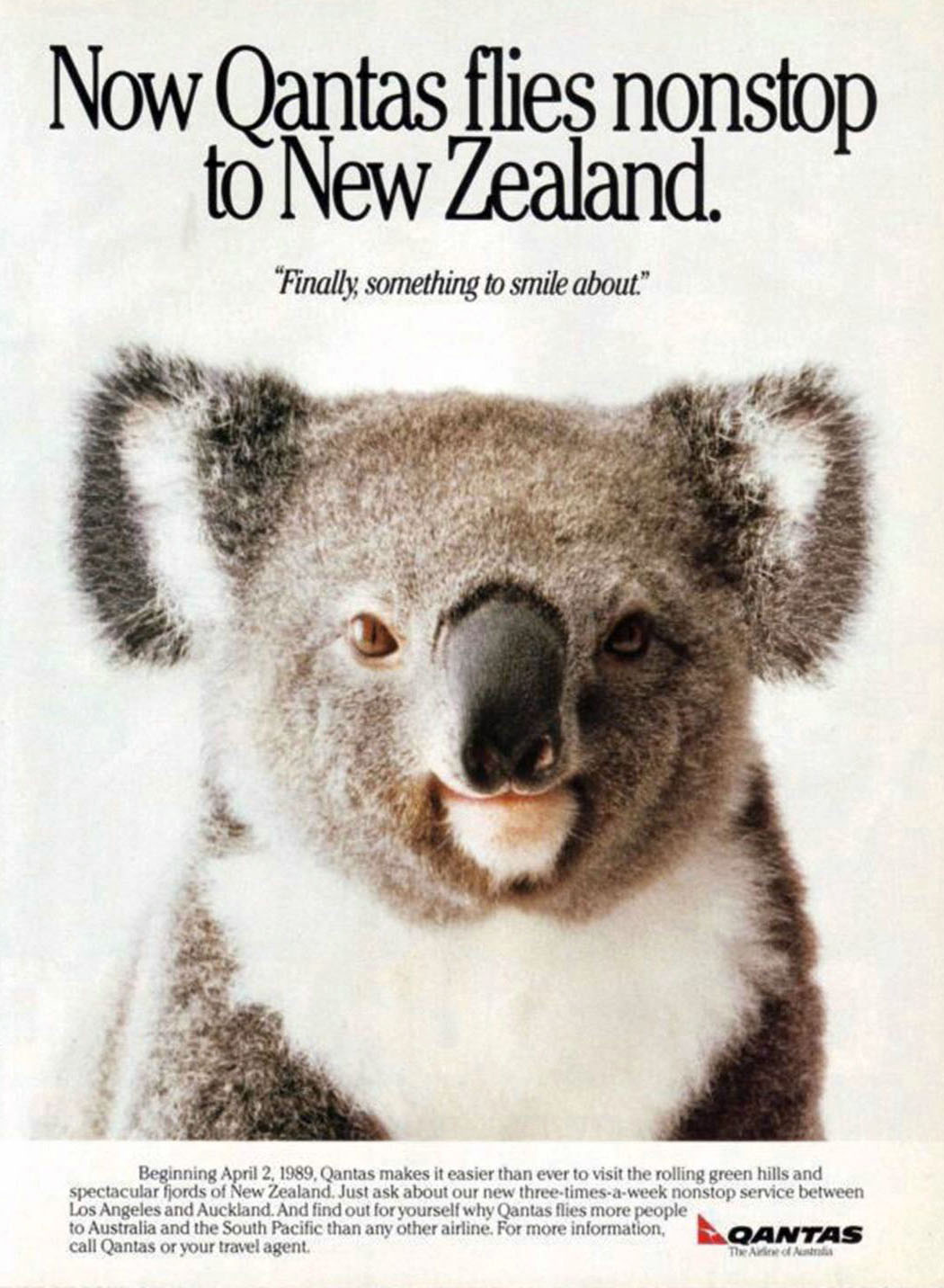
A grumpy koala that lived by the motto “I Hate Qantas” featured in Qantas TV adverts from 1962 to 1992.
Devised by Qantas’ US advertising agency, the live koala voiced by the late actor Howard Morris, bemoaned Qantas for bringing tourists to Australia and disturbing its solitude.
The grumpy koala was given something to smile about in 1989 when Qantas launched a non-stop service between Los Angeles and Auckland.
Qantas Los Angeles – Auckland Non-Stop, 1989
“The Flying Kangaroo”
Very 1980s!
“We’re Coming To Get You”
“I Still Call Australia Home”
“I Still Call Australia Home” is one of Qantas’ most famous advertising campaigns.
The latter adverts featured children’s choirs performing Peter Allen’s song at various locations around the world. This was at a time when airlines had the budgets for such extravagance.
Qantas Boeing 707-138 “City Of Canberra” (Image Credit: Qantas)
On the afternoon of 26 May 1971, staff at Qantas House in Sydney received an unexpected telephone call.
At 12:15pm local time, a man identifying himself only as “Mr Brown” advised Qantas that a barometric bomb had been placed on board one of its Boeing 707 aircraft.
The aircraft had left Sydney 45 minutes earlier and was en route to Hong Kong with 116 passengers and 12 crew members.
Mr Brown claimed the bomb would be automatically exploded by a change in air pressure as the aircraft descended from its normal cruising altitude of 30,000 feet to 20,000 feet.
To prove that he was not bluffing Mr Brown advised that a similar bomb had been placed in a locker at Sydney airport. The bomb, made of gelignite with an altimeter-triggered detonator, was located shortly afterwards.
With the second bomb there were three typewritten notes. One written to Qantas General Manager Captain R J Ritche demanded AU$500,000 in exchange for instructions on how to locate and dismantle the bomb on board the aircraft.
To test the veracity of Mr Brown’s threat, the second bomb was diffused. Its explosives were replaced with a light bulb. The diffused bomb was put on board a second Boeing 707. It climbed to 8,500 feet. When it descended back to 5,000 feet the light bulb lit up.
Qantas immediately notified the aircraft’s Captain, William Selwyn. A thorough search of the aircraft was ordered. Passengers were only told that there was a technical difficulty – though many could tell that a bomb was suspected to be on board – and the aircraft would have to circle in the air until it could land in Sydney.
The aircraft returned to the East Coast of Australia and spent three hours circling over Brisbane and a further two and a half hours circling over Sydney.
With the aircraft running out of fuel, Qantas agreed to pay the AU$500,000 ransom. After hurriedly securing funds from its bank, without time to take numbers of the bank notes, a drop off was arranged outside Qantas House. The money was placed in two suitcases and put in the back of a van.
After doing so, Qantas was told there was no bomb on board the aircraft. The bomb threat was a hoax. The aircraft then landed safely in Sydney with just 15 minutes’ fuel left. Military aircraft and navy vessels were deployed by the Australian government in case the aircraft did not land safely.
In the first part of our series on Qantas in the UK, we looked at its early co-operation with Imperial Airways and BOAC. In part two we looked at how the Boeing 707 established Qantas as a round-the-world airline. Part three looked at how the Boeing 747 transformed flying to Australia.
“No British Airways ownership of our Qantas. Piss off poms.”
By the end of the 20th century Qantas remained the dominant airline carrying passengers to Australia with an around 40% share of international traffic.
This was owed, in part, to a close relationship over many decades with BA and its predecessor airlines Imperial Airways and BOAC.
BOAC Qantas Kangaroo Route 25th Anniversary, 10 December 1959
In 1993, when BA had ambitions to be a major global airline, it beat Singapore Airlines to acquire a 25% stake in Qantas in ahead of its full privatisation in 1997.
Not everyone was enamoured with the idea. One particularly dissatisfied Australian put up a sign “No British Airways ownership of our Qantas. Piss off poms.” at Sydney airport.
BA and Qantas formed a joint-business in 1995 to co-operate on Europe – Australia services. This involved co-ordination of fares, schedules and many joint airport lounges throughout Asia. BA and Qantas also shared aircraft, with BA leasing 7 Boeing 767 aircraft to Qantas.
At the turn of the century, with a focus on reducing complexity in its operations, BA turned its attention away from Australia. To reduce the amount of debt on its balance sheet BA also sold its stake in Qantas.
Meanwhile, Qantas saw its future in the Airbus A380 carrying ever larger numbers of passengers to Europe and the Middle East. Towards the end of 2000, Qantas ordered 12 aircraft. A further 8 were ordered in 2006 (International Herald Tribune), but this was subsequently cancelled.
BA and Qantas explored a merger in 2008. The deal was pulled after the two airlines could not agree on the relative shares in the combined business. Given the physical distance between the UK and Australia, it is hard to see how the merger could have achieved the synergies BA has done with Iberia. Legally, it would have to had to comply with the Qantas Sale Act which caps foreign ownership of Qantas. It could have also faced huge political opposition in Australia.
In the first part of our series on Qantas in the UK, we looked at its early co-operation with Imperial Airways and BOAC. In part two we looked at how the Boeing 707 allowed Qantas to establish itself as a round-the-world airline.
It is no exaggeration to say that, throughout the 1970s and 1980s, the Boeing 747 transformed flying between Europe and Australia, enabling it to be ultimately reached with just one stop en route.
The Boeing 747B At Qantas
Qantas Boeing 747-238B “City Of Canberra” (Image Credit: Qantas Airways)
Qantas’ first Boeing 747 aircraft was the 747B. This had the same dimensions as the first version of the 747, but with a longer range and higher maximum take-off weight.
It had capacity for 356 passengers, with the galleys located below the main deck. In common with other airlines, there was a dedicated “Captain Cook” lounge for First Class passengers on the Upper Deck with a nautical theme and a rather lurid 1970s colour scheme!
Qantas Boeing 747 First Class Captain Cook Lounge, 1970s (Image Credit: Qantas Airways)
The economy cabin shows that the 1970s was certainly the decade that taste forgot.
Qantas Boeing 747 Economy Class Cabin, 1970s (Image Credit: Qantas Airways)
Qantas’ first Boeing 747 flight departed London Heathrow for Sydney via Bahrain and Singapore on Friday 26 November 1971. Flights initially operated twice weekly on Fridays and Sundays.
In March 1974, Qantas added a second one-stop service from London Heathrow to Perth via Mumbai with a journey time of around 20 hours.
In the first part of our series on Qantas in the UK, we looked at Qantas early co-operation with Imperial Airways and BOAC and its own first flights to London.
Over the course of the 1960s, Qantas entered the jet age, operating the Boeing 707 on routes from London. This delivered radical improvements to journey times and increased the scope of its global network.
Qantas Boeing 707 Jets From London, 31 July 1959
The first Qantas Boeing 707 routes from London operated to Sydney via the Pacific. The first flight departed London on 31 July 1959, two days after its inaugural flight from Sydney to San Francisco.
Passengers could fly from London to Sydney via San Francisco in just over 30 hours, saving over 25 hours’ journey time. It would shortly fly the “Kangaroo Route” to Australia via Singapore.
“Qantas – Round The World By Jet” Boeing 707 Flights from London to Sydney via the US and Asia.Qantas Boeing 707 Jets Around The World, October 1959
“Fastest Jets To USA & Australia”
Two years later in 1961 introduced a special version of the Boeing 707 known as the “V Jet”.
This had more powerful engines, delivering more journey time improvements from London to Sydney.
On 16 November 2020, Qantas will mark 100 years since its incorporation as Queensland and Northern Territory Aerial Services Ltd. It would soon become known as Q.A.N.T.A.S. and then Qantas.
It was many decades in to its existence before Qantas started flying to the UK in its own right. Together with BA’s predecessor airlines Imperial Airways and BOAC, it pioneered the first flights between the UK and Australia from the 1930s.
On 8 December 1934, the first UK to Australia mail service began operated by Imperial Airways (from Croydon to Karachi), Indian Trans-Continental (Karachi to Singapore) and Qantas Empire Airways, formed by Qantas and Imperial Airways, (Singapore to Brisbane).
The event was marked by a special ceremony at Croydon presided over by Lord Londonderry, Secretary of State for Air. Included in the two tons of letters were three addressed by the King, the Queen, and the Prince of Wales to the Duke of Gloucester at Auckland.
Imperial Airways Air Mail Services, December 1934
The next year, on 13 April 1935, the first passenger service operated from London to Brisbane by Imperial Airways and Qantas Empire Airways. It initially operated weekly and the trip took 12 and a half days. It would become officially known as the Kangaroo Route.
Services initially operated weekly, and were progressively increased to twice weekly and thrice weekly throughout the 1930s. The journey time was improved so that flights to Australia took “only” 10 days.
Imperial Airways Services To Australia, May 1936Imperial Airways Flying Boats, March 1937Imperial Airways Flying Boats, May 1939
By 1939, services to Australia were operated with flying boats. Passengers would depart from the Imperial Airways Terminal in Victoria to catch a train to Southampton.
Welcome to London Air Travel’s Monday Briefing for the week beginning 9 November 2020.
Qantas Prepares To Mark Its Centenary
Next Monday, 16 November, Qantas will mark 100 years since its incorporation as Queensland and Northern Territory Aerial Services Ltd.
With the aviation industry in a state of crisis, there is little cause or scope for celebration. At least Qantas can say this wasn’t of its own making.
It was rather fitting that in one of the earliest advertisements for the airline in November 1920, its name was printed incorrectly (this time as Northern Territory and Queensland Aerial Services Ltd), something that has continued for decades.
Queensland And Northern Territory Aerial Services Ltd Advertisement, New South Wales Aerial Derby Programme, November 1920
It was in the 1930s that Qantas began international services, forming Qantas Empire Airways with one of BA’s predecessor airlines, Imperial Airways.
The two airlines jointly operated the first regular air mail service between the UK and Australia in December 1934, with Qantas Empire Airways operating the route between Singapore and Australia.
Regular scheduled passenger service between the UK and Australia would begin in April 1935. The first trips took no less than 12 and a half days.
When commercial aviation resumed after the Second World War, Qantas began operating services to London in its own right using the Lockheed Constellation aircraft
In 1954, Qantas operated the “Southern Cross” route to Sydney via New York, San Francisco, Honolulu and Fiji. This would later be operated as a single around the world route with Super Constellation aircraft.
In the 1960s, aided by the Boeing 707, Qantas would introduce a second eastbound service to Australia via Hong Kong and another westbound service to Australia via Bermuda, Mexico and Tahiti, known as the “Fiesta route”.
The Boeing 747 introduced in 1971 transformed services between the UK and Australia, eventually enabling Australia to be reached with just one stop in Asia.
By the end of the 20th century Qantas remained the dominant international airline carrying passengers to Australia. Its status as the global airline for Australians was illustrated in its most famous TV advertising campaigns featuring children’s choirs performing Peter Allen’s “I Still Call Australia Home”.
Virgin Atlantic Airbus A330neo Aircraft (Image Credit: Virgin Atlantic)
Virgin Atlantic is to launch a new route from London Heathrow to the Caribbean island of St Vincent from June 2021.
This will be the only direct service to the island from Europe. Virgin Atlantic will fly to St Vincent twice weekly. The island is served by Argyle International Airport.
Flights will operate twice weekly with Airbus A330-300 aircraft. As is par the course with new route announcements Virgin Atlantic, flights have not yet gone on sale. Nor has Virgin provided an indicative schedule. Flights should be on sale from Tuesday 24 November.
This move reflects, in part, a “pivot” to leisure traffic. Virgin’s official release alludes to relatively less stringent COVID-19 testing and quarantine restrictions in the Caribbean. Though, in truth, nobody knows what COVID-19 travel restrictions will be in place in six months’ time.
At present, all Virgin Atlantic flights are operating from London Heathrow Terminal 2. No date has been given for the reopening of Terminal 3. Based on current trends, this will be many months away.