Flybe De Havilland Canada Dash 8-400 Aircraft, London City Airport (Image Credit: London City Airport)
Welcome to London Air Travel’s Monday Briefing for the week beginning 6 December 2021.
Flybe To Be Sold Again?
Today’s Telegraph has an interesting story – not online at the time of “going to press” – that Cyrus Capital is looking to sell Flybe.
Cyrus Capital was a member of the Connect Airways consortium that bought Flybe along with Virgin Atlantic and Stobart Air. It was described at the time by then IAG CEO Willie Walsh as “a business model that doesn’t work with shareholders that have suddenly cottoned on that they’ve bought a dog”.
Cyrus bought the assets of Flybe, using a vehicle known as Thyme Opco Ltd – now renamed Flybe Ltd, after it went into administration in March 2020.
Last month, Flybe announced with great fanfare that it is to start operations from a base in Birmingham in early 2022. It also plans to have a fleet of up to 32 De Havilland Canada Dash 8-400 turboprop aircraft.
The Telegraph reports that the owners of Flybe are looking for a new investor to operate Flybe in partnership for around a year before the airline is sold. Airlines such as Aurigny and Blue Islands are said to have been sounded out.
It is claimed that a sale of the airline would come with the London Heathrow bmi remedy slots that that the “old” Flybe acquired from BA. These 186 weekly slots, equivalent to 12 return flights a day, were taken back by BA in June 2020 after Flybe entered into administration. They were readvertised to potential bidders, but with a warning they were subject to a legal dispute.
However, a filing with Airport Coordination Ltd from earlier this year shows that 86 weekly slots for the winter 2021 season were transferred back from BA to Flybe.
This latest development will fuel speculation that the motives behind the purchase of Flybe’s assets out of administration were primarily to realise the value of its Heathrow remedy slots.
This is particularly so when the wisdom of launching a new regional airline is questionable after many rival airlines have moved to replace the routes formerly operated by Flybe and business travel is likely to remain depressed well into 2022.
British Airways Concorde Logo (Image Credit: British Airways)
This article was published in 2019 in a series on the history of British Airways and its predecessors Imperial Airways, BOAC and BEA. You can browse all 100 stories in number order, by themeor by decade.
Many have been updated since first published.
“You leave. Arrive before”.
That was the promise of Concorde.
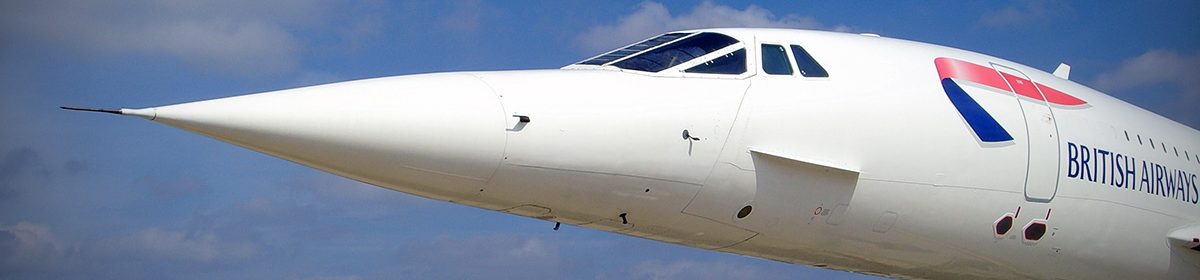
One of the 20th century’s greatest design icons and the world’s only supersonic aircraft, flying at around twice the speed of sound at 1,350mph and at an altitude of 60,000 feet.
Concorde was in commercial service at BA from 21 January 1976 to 24 October 2003. In that time more than 2.5 million passengers flew on the fleet of seven aircraft.
It operated scheduled services principally to New York JFK, but also at times to Barbados, Bahrain, Dallas Fort Worth, Miami, Singapore and Washington.
Concorde also operated charter flights to over 250 destinations worldwide, including annual flights to Lapland.
It had a relatively small, but fiercely loyal customer base – with some 80% repeat passengers. One of its most frequent passengers was an oil industry executive who notched up 70 return trips a year.
Concorde also benefited from its own dedicated “cellar in the sky” wine collection and the promise that bags would be delivered to passengers within 8 minutes of arrival.
Sir Terence Conran said of the aircraft in the foreword to the book “Supersonic – The Design And Lifestyle Of Concorde”:
Concorde is the most iconic aircraft of all time and I can honestly say it is the most beautiful and exhilarating man-made object I have ever seen. It is one of the few designs to take my breath away.
Do not think I exaggerate when I say Concorde is the single most important piece of design in my long lifetime. Will we see anything quite so elegant, beautiful and optimistic again? I’m sad to say perhaps not, but that may be the challenge for our great designers, engineers, innovators and artists. Can you work together to create something beautiful, powerful, and iconic it pushes the boundaries of our imagination. Can you make us dream like that again? Can you show us the future?
Concorde Inaugural Flights & Routes
Concorde began scheduled passenger flights with a twice weekly service from London Heathrow to Bahrain on 21 January 1976.
British Airways Concorde Publicity, Launch of ticket sales to Bahrain, October 1975British Airways Concorde Publicity, Pre-launch of services to Bahrain, 13 January 1976British Airways Concorde Publicity, Pre-launch of services to Bahrain, 21 January 1976.
In preparation for its launch BA created a dedicated check-in area at London Heathrow Terminal 3 with a check-in time of 45 minutes, a dedicated lounge and the promise of a short walk to the aircraft.
One passenger on the inaugural flight was Bob Ingham, who reportedly saved up for three years for a ticket and wore an outfit he deemed appropriate for the inaugural flight.
Passenger Bob Ingham, Concorde Check-in, London Heathrow Terminal 3, 21 January 1976 (Image Credit: SWNS / London Heathrow Airport)Concorde, London Heathrow, 21 January 1976 (Image Credit: SWNS / London Heathrow Airport)
A few months later, on 24 May 1976, BA operated its inaugural Concorde service from London Heathrow to Washington Dulles. Services to Washington would run until late 1994.
British Airways Concorde Publicity, Pre-launch of services to Washington, 20 April 1976
It took some time to secure approval for Concorde to fly to New York JFK, which proved to be the last Concorde route. Concorde began scheduled services to New York on 22 November 1977.
In December of that year, the Concorde service to Bahrain was extended to Singapore, operated in conjunction with Singapore Airlines.
Flights to Singapore had to use Indonesian airspace as Malaysia refused to allow the use of its airspace on environmental grounds. Flights were temporarily suspended for a year until Malaysia allowed use of its airspace in December 1978.
British Airways Concorde Publicity, Pre-launch of services to New York and Singapore, 28 October 1977.
On 12 January 1979, Concorde’s service to Washington was extended to Dallas / Fort Worth, with that sector operated by Braniff International crew. The service to Dallas was suspended by Braniff in June 1980, citing rising fuel costs.
British Airways, Concorde, London Heathrow – Washington, January 1979Braniff International, Concorde, Washington – Dallas Fort Worth, January 1979
On 27 March 1984, BA’s Concorde service to Washington was also extended to Miami three times weekly.
Concorde, London Heathrow – Miami, via Washington Dulles, 1984
It was hoped that Concorde services would be extended to Sydney (via Bahrain & Singapore), Tokyo (via the Soviet Union) and Johannesburg (via Nairobi). For a variety of reasons, including political, these did not come to fruition.
Concorde Charter Flights
In its 27 year history Concorde operated many charter flights.
These were not just for members of the Royal Family and senior politicians, but also members of the public.
By the mid-1980s Concorde had developed a very lucrative charter business which made the aircraft much more accessible to the public.
One notable trip took place in February 1985 when a Concorde completed a trip from London to Sydney in 17 hours, 3 hours and 45 seconds as a charter for Cunard. The aircraft landed in Sydney on 14 February 1985 having stopped in Bahrain, Colombo and Perth for refuelling. The day before, BA took out a full page advert in The Times with the message “DARLING SYDNEY Will be breaking all records to be with you on the 14th Love Concorde XX.”
Other charters for Cunard included Cape Town. On 28 March 1985, Concorde broke the speed record for a flight from London to Cape Town, taking eight hours and eight minutes with a refuelling stop in Monrovia, Liberia. This beat the previous record of 11 hours and 54 minutes, set by a Boeing 747 in 1977.
Concorde Aircraft & Liveries
British Airways Concorde G-BOAD, Negus Livery (Image Credit: Heathrow)British Airways Concorde Landor Livery (Image Credit: British Airways)British Airways Concorde G-BOAF Chatham Dockyard Livery (Image Credit: British Airways)
British Airways Concorde Advertising
Concorde was used relatively sparingly in BA advertising. Partly because of exclusivity, and partly because it’s not the sort of service that needs advertising.
BOAC Boeing 747-136 aircraft (Image Credit: British Airways)
Pan American World Airways, for whom the Boeing 747 aircraft was designed, was the first airline to operate passenger flights, from New York to London on 21 January 1970.
It may seem strange to think now, but there were doubts as to whether airlines could fill the aircraft with passengers. In addition, there were concerns about the ability of airports to handle the aircraft, at the time the biggest passenger jet in service. Both London Heathrow and New York JFK had to implement makeshift arrangements to handle the aircraft.
“All the 747 needed was BOAC service.”
BOAC began passenger flights from London to New York on 14 April 1971.
It had been delayed by a year, partly due to an industrial dispute with its pilots. You can see footage of the cabin interior, with its Monarch lounge on the upper deck in this video:
The 747 would be progressively added to many North American routes.
This article was published in 2019 in a series on the history of British Airways and its predecessors Imperial Airways, BOAC and BEA. You can browse all 100 stories in number order, by themeor by decade.
Many have been updated since first published.
It was in January 1988 that BA introduced the “Club World” brand, roughly ten years after the concept of long-haul business class first became known.
Initially, long-haul business class was simply a separate part of the economy cabin for full fare passengers. Then, BA introduced its Super Club cabin.
BA claimed that the introduction of Club World in 1988 which featured a dedicated crew for the first time, improved catering and ground services, increased traffic by 31%.
Since then, Club World has become by far BA’s most important cabin and it has featured the airline’s biggest innovations. The financial performance of BA is inextricably linked to the volume of Club World traffic. So much so, it was to become known as the “profit engine” of BA.
The First Club World Seats
The initial Club World seat was a “slumber seat”.
In the 1990s, BA maintained a regular pace of change in the cabin. Another new cabin interior and seat was introduced in the early 1990s with seat-back TV for the first time.
British Airways Club World Advert 1993
The Cradle Seat
The next significant change to Club World came with the “Cradle Seat” in 1996.
British Airways Club World Cradle Seat
The concept behind this seat was that rather than simply reclining, the seat would tilt and, with the aid of “ears” in the headrest and a built in leg-rest, it would support the entire body whatever the position of the seat.
“Presenting a revolutionary view from business class”
At the turn of the century, BA announced one of the most significant innovations in its history, the first fully flat bed in business class.
British Airways Club World Cabin, 2000
Designed by tangerine, it featured a patented “yin-yang” layout of rear and forward facing seats that would convert into fully flat beds.
British Airways Logo (Image Credit: British Airways)
This article was published in 2019 in a series on the history of British Airways and its predecessors Imperial Airways, BOAC and BEA. You can browse all 100 stories in number order, by themeor by decade.
Many have been updated since first published.
BA, like much of the world, entered the 21st century with a sense of optimism.
There had been some difficult years with the adverse reaction to World Tailfins. The airline was also facing increased competition from low cost carriers and in 1999 reported its worst financial results since 1982.
“21st Century Air Travel”
However, at the turn of the century, there was a cause for optimism.
One event of course changed everything. 11 September 2001 was the single worst day in aviation history. The events of that day and its substantial human cost are well known. It had a profound impact on the US psyche and global geopolitics which are still felt to this day.
For BA, there was the immediate impact of the closure of US airspace to all civil aviation. 22 BA aircraft were diverted.
The Federal Aviation Administration placed an immediate ban on all non-US airlines flying to the US until such time they could be satisfied that security conditions could be met. US airspace reopened to domestic airlines two days later. The FAA gave BA permission to fly to the US again on 15 September 2001.
The Times, Europe Edition Front Page, Wednesday 12 September 2001The Guardian, Europe Edition Front Page, Wednesday 12 September 2001
At the time many wondered whether air travel would ever be the same again with some speculating that airports would have to be rebuilt to accommodate additional passenger screening processes.
Many security measures were implemented such as installing armour plated cockpit doors and the submission of advance passenger lists to US authorities.
BA subsequently announced a review of its business which became known as “Future Size and Shape”. This resulted in a substantial cut in capacity, thousands of job losses, and numerous cost-cutting initiatives – many of which did not go unnoticed by passengers.
This set the course for BA the rest of the decade with a focus on improving its balance sheet by selling its 25% stake in Qantas and disposing of regional operations, simplifying its fleet, removing legacy complexity and no significant capacity growth. It was only towards the start of this decade did BA start growing again.
Many at BA’s parent IAG, mindful that Ryanair was able to secure a substantial discount from Boeing for new aircraft after 11 September 2001, are determined that this does not happen again. Put in fairly crude terms, they want the next shock to the aviation industry to be an opportunity, not a problem, for IAG.
London Heathrow Terminal 1, 1969 (Image Credit: Heathrow Airport)
This article was published in 2019 in a series on the history of British Airways and its predecessors Imperial Airways, BOAC and BEA. You can browse all 100 stories in number order, by themeor by decade.
Many have been updated since first published.
London Heathrow airport has been BA’s principal UK hub for the entirety of its, and much of its predecessors, existence.
Whilst the airport has its operational constraints and at times BA has had a difficult relationship with its owner that could be summed up as “Can’t live with you. Can’t live without you.”, if affords the airline a dominant position in one of the most lucrative premium traffic markets in the world.
This is so much so that rival airlines are prepared to pay tens of millions of dollars for a single pair of arrival and departure slots.
The Origins of Heathrow
Heathrow traces its origins to the 1920s.
In 1925, RAF test pilot Norman MacMillan was forced to make an emergency landing at the small rural hamlet of Heathrow and considered the terrain ideal for an airfield.
Four years later Norman MacMillan joined forces with British aero-engineer Richard Fairey who needed a new airfield for his aircraft-building business. Richard Fairey bought 150 acres of farm land at Heathrow and built a new aerodrome, to be known as the Great West Aerodrome.
The site was requisitioned by the Air Ministry during World War Two. An RAF base was built on the site with three runways and a control tower. Following the end of World War Two it was considered surplus to requirements.
After The Second World War: London Airport Opens
On 1 January 1946, ownership of Heathrow passed to the Ministry of Civil Aviation.
On that day, the first flight to depart the airport was a British South American Airways “proving” flight to South America operated by a Lancastrian Star Light. The aircraft, carrying mail and freight only, arrived in Rio de Janeiro 32 hours later, before continuing to Montevideo and Buenos Aires.
British South American Airways Avro Lancastrian Starlight Aircraft, London Heathrow Airport, 1946 (Image Credit SWNS / London Heathrow Airport)
The first passenger flight to arrive at the airport a BOAC flight service from Sydney on 31 May 1946. The Lancaster aircraft took 63 and 1/4 hours to fly from Sydney, landing 2 hours ahead of schedule. BOAC’s three times weekly “express” service to Sydney was the first route the airline transferred to London airport, having previously operated from Hurn (also known as Bournemouth International) airport.
Pan American World Airways and American Overseas Airlines transferred services to New York from Hurn to London Airport that week.
Passengers pictured arriving at London Airport from a Pan American World Airways flight from New York, 31 May 1946 (Image Credit: SWNS / London Heathrow Airport)
The airport was a far cry from the modern terminals of today. Passengers initially used former military marquees along Bath Road as departure and arrival terminals that were exposed to the elements.
– though there was a branch of WH Smith!
London Airport, 1946 (Image Credit: SWNS / London Heathrow Airport)
Each marquee was equipped with floral-patterned armchairs, settees and small tables containing vases of fresh flowers. There was also a branch of WH Smith! To reach aircraft parked on the apron, passengers walked over wooden duckboards to protect their footwear from the muddy airfield.
Departure Lounge, London Airport, 1946 (Image Credit: SWNS / London Heathrow Airport)
The 1950s – The Central Area & Europa Terminal Open
Baggage Sorting Area, London Heathrow, 1950s (Image Credit: Heathrow)
As passenger numbers grew in the 1950s, architect Frederick Gibberd was commissioned to design permanent buildings for the airport.
The Central Area was created, along with the Europa Terminal, an office block known as The Queens Building (pictured below in the 1977), and a 127 feet Control Tower. The new terminal was officially opened by Queen Elizabeth II on 16 December 1955.
Her Majesty The Queen, Heathrow Airport, 1977 (Image Credit: Heathrow)
The 1960s – The Oceanic Terminal & Terminal 1 Open
Terminal 3 opened in 1961 and was originally known as the Oceanic Terminal and became the principal base for long haul flights.
The 1960s was the era of the emergence of the celebrity and popular culture. Many famous faces from The Rolling Stones to Joan Collins would be pictured departing London airport on BEA and BOAC aircraft.
In September 1996 London Airport was renamed Heathrow. This was intended to distinguish it from Gatwick and Stansted, which at the time were all owned by the British Airports Authority.
Terminal 1 was officially opened by Queen Elizabeth II in April 1969. BEA operated the first flight out of Terminal 1, BEA 5362 to Edinburgh, on 17 April 1968.
On the opening of Terminal 1, the Oceanic and Europa terminals were renamed Terminals 2 & 3 respectively.
Baggage Belt, Terminal 1, London Heathrow 1960s (Image Credit: Heathrow)
BA’s main home at Heathrow was Terminal 1 from 1968 to 2008 until the opening of Terminal 5, with a brief reprise from 2012 to 2015 following BA’s purchase of bmi. BA operated the last flight out of Terminal 1, BA970 to Hanover, on 30 June 2015.
The 1970s – The Jumbo Jet & Supersonic Era
In the 1970s, Heathrow readied itself for the era of the jumbo jet and Supersonic air travel.
Terminal 3 had to modified to accommodate the Boeing 747 which was more than twice the size of its immediate predecessor, the Boeing 707.
Ahead of the launch of scheduled Concorde flights to Bahrain in January 1976, part of Terminal 3 was converted into an exclusive Concorde terminal with a dedicated check in area, with an escalator to Concorde lounge, adjacent to the boarding gate for Concorde. Passengers were also promised that their luggage would go direct from check-in to the hold aircraft.
The 1980s – Terminal 4 Opens
Terminal 4 when it opened in 1986, at a cost of £200 million, became BA’s principal base for long haul flights, with a small number of short haul routes.
Terminal 4 Under Construction, London Heathrow Airport (Image Credit: Heathrow)
The terminal was officially opened by the Prince Charles & Diana, Princess of Wales on 1 April 1986. It opened to passenger flights shortly after on 12 April 1986.
Prince Charles, Princess Diana, London Heathrow Terminal 4, April 1986 (Image Credit: SWNS / London Heathrow Airport)
Although Terminal 4 was intended to ease congestion in the Central Area, it was ill-suited in its design for long-haul flights. It was located south of the southern runway, so you had to cross an active runway to reach the north runway.
The 1980s saw BA launching more long haul routes at Heathrow with services to Bogota, Caracas, Rio de Janeiro, São Paulo, Orlando, Pittsburgh and Tampa in 1985.
The 1990s – American Airlines, United & Virgin Atlantic Enter Heathrow
1991 was a significant year for Heathrow. Under a treaty between the UK and US governments only BA, Pan American World Airways and Trans World Airlines could fly to the US from the airport.
All other airlines, notably Virgin Atlantic and a number of US airlines following the deregulation of US aviation in 1978, had to fly from Gatwick.
Both Pan Am and TWA were heavily indebted and reeling from the collapse of international travel following the Gulf War, rising oil prices. Many clients, particularly business customers, actively avoided Pan Am the aftermath of the Lockerbie disaster.
Pan Am entered Chapter 11 bankruptcy protection in early 1991. It sought to raise around $290 million by selling its London routes to United Airlines. American Airlines purchased TWA’s London routes for $440 million.
This required a renegotiation of the bilateral treaty between the UK and the US. It also required a change in UK law which barred new airlines flying from Heathrow, which was intended to facilitate growth at Gatwick. This was lifted by the UK government in March 1991.
Virgin Atlantic started flying from London Heathrow to New York JFK and Los Angeles from July. In classic fashion, Sir Richard Branson dressed up as a pirate, covered a model BA Concorde at Heathrow with a Virgin logo and declared the airport “Virgin Territory”. This marked a significant deterioration in the relationship between the two airlines.
In total, the number of airlines competing against BA at Heathrow increased from 70 to 87.
The 2000s – Security Alerts & Industrial Relations Tensions
Following the events of 11 September 2001, BA embarked on a process to streamline its business and cut costs.
Many routes to Central & South America were transferred to Gatwick in the 1990s moved back to Heathrow. Denver, Phoenix, San Diego, Harare and Lusaka were also moved to Heathrow. Other Heathrow routes such as Manila and Taipei were suspended.
The process of reforming working practices and reducing labour costs was not an easy one. BA ground staff at Heathrow walked out at the start of the summer holidays in July 2003 over the introduction of a new swipe card system. Whilst industrial action in aviation wasn’t new, wildcat strike action at the time was very rare.
BA faced a call for industrial action by ground staff over the August 2004 bank holiday. This was called off, but the airline had offer a profuse public apology when it was forced to cancel many flights at Heathrow due to unexpected staff shortages.
A third consecutive summer of unofficial industrial action followed in 2005 when BA ground staff worked out in support of employees sacked by its catering supplier Gate Gourmet. The sight on TV news bulletins of passengers queuing in tents outside terminals would become a familiar one.
The airline remained exposed to geopolitical events. In August 2003, BA temporarily suspended flights to Jeddah and Riyadh on UK government advice of “credible intelligence of a serious threat to British aviation interests in Saudi Arabia”.
BA223 from Heathrow to Washington Dulles was also cancelled on New Year’s Day 2004 due to security concerns. Passengers on the previous days flight were interviewed on arrival and the cargo hold of the aircraft was searched. BA was also forced to cancel further flights to Washington and Saudi Arabia on 15 and 16 February 2004 respectively due to security concerns.
A plot to blow up a flight from London to the US in August 2006 prompted very severe restrictions on hand baggage and very public criticism by then CEO Willie Walsh over security queues and Heathrow forcing airlines to reduce their schedules.
Ongoing restrictions on hand baggage had a significant impact on transfer traffic. BA’s baggage handling infrastructure at Terminals 1 and 4 struggled to handle the volume of additional checked luggage.
That said, it wasn’t all doom and gloom. The introduction of a new premium check-in area in 2004, Zone R, and a new First Class lounge in Terminal 1 proved popular with frequent flyers.
Whilst this era was largely one of contraction, BA did add Calgary, Hyderabad and Shanghai to its network at Heathrow.
Whilst it did, after bedding down, deliver operational improvements, severe disruption due to heavy snow at Christmas 2010 exposed a still dysfunctional relationship between Heathrow and its airlines.
British Airways Airbus A320 Aircraft G-BUSK, London Heathrow Terminal 5 (Image Credit: British Airways)
Relations between the airport and airlines have improved to a degree. There is at least at a more proactive approach to capacity reductions ahead of severe weather.
The acquisition of bmi British Midland in 2012 has cooled BA’s enthusiasm towards a third runway. IAG does not pull any punches regarding its costs of and effectively accuses Heathrow of misleading the public.
Should a third runway ever be constructed it will have a competitive impact on BA. easyJet has indicated it will seek access to Heathrow and a number of long-haul airlines will also be able to secure access and / or more competitively timed slots. That all said, no-one can predict the state of the industry by the time the third runway opens.
This article was published in 2019 in a series on the history of British Airways and its predecessors Imperial Airways, BOAC and BEA. You can browse all 100 stories in number order, by themeor by decade.
Many have been updated since first published.
The former editor of the Daily Mail, Paul Dacre (feared and admired in equal measure in corridors of power) once told Willie Walsh that stories about BA were guaranteed to make its front page, whereas for its UK rivals, they would not.
BA has been privatised for over 30 years and is indeed now part of a Spanish registered company. It has had Australian, Irish and Spanish CEOs. Much to the irritation of Willie Walsh, everyone will have an opinion on and a sense of ownership of BA, and he really wishes you didn’t.
However, an airline’s national location has always played a role in its identity. Over time, BA has oscillated between an overtly British identity and an ambition to be seen as a global airline.
“British And Proud Of It”
The first BA Negus & Negus livery introduced for BA was amended in 1980 to be simply “British”. However, this was considered too nationalistic in tone.
“British Airways, British and proud of it”, August 1980
The subsequent Landor livery, whilst maintaining a strong British identity, was considered controversial by some at the time because BA chose a Californian design firm to create it.
“Johnny Foreigner”
In the 1990s, BA saw itself as a global airline. The most significant illustration of this was of course the World Images tail fins which received a well publicised backlash for its removal of the union flag.
In 1999, BA recruited the American writer PJ O’Rourke to poke fun at British eccentricities and give British viewers a gentle ticking off for not being more proud of their de-facto national carrier.
“The British Simply Know How To Travel”
How countries are perceived by their own residents and visitors does of course vary widely and this is often reflected in airline advertising.
Here in 2000, BA used the strap line “The British simply know how to travel” in its advertising in the United States to highlight the clear difference between BA and US carriers at the time, as illustrated in this advert featuring cricket and strawberries.
(Any international passengers who have flown BA with any degree of frequency, but have never lived here, would think that all Britons do is eat Afternoon Tea – a meal that nobody who actually lives in the UK ever eats.)
British Airways New Club World Advertisement circa 2006 (Image Credit: British Airways)
This article was published in 2019 in a series on the history of British Airways and its predecessors Imperial Airways, BOAC and BEA. You can browse all 100 stories in number order, by themeor by decade.
Many have been updated since first published.
If there’s one route more important to BA than any other, its London – New York, linking two major global financial centres.
BOAC operated its first commercial flights from the newly opened London Airport to New York, with stops in Shannon and Gander, in July 1946.
At the time it was competing with Pan American World Airways and American Overseas Airlines who had already launched services to New York from Hurn (now Bournemouth International) airport following the end of the Second World War.
Good news for British commercial flying, with the opening at Heathrow of BOAC’s constellation air service between London and New York. These super airliners are even equipped for showing films during the Atlantic crossing. Passengers go on board for the first flight of the new service, a service only made possible by the British pioneers of the past, who’ve turned a high adventure into an everyday affair.
In 1950, BOAC introduced a dedicated “Monarch” service to New York, initially with the Stratocruiser aircraft. This was extended to other aircraft such as the Comet 4.
BOAC Monarch Service, London Heathrow – New York, 1960
In March 1990, BA added a second New York airport to its route network with a new route to Newark. This was initially operated with a Lockheed L-1011 aircraft. By the mid 1990s, BA operated seven services a day to New York.
British Airways First Class Cabin (Image Credit: British Airways)
This article was published in 2019 in a series on the history of British Airways and its predecessors Imperial Airways, BOAC and BEA. You can browse all 100 stories in number order, by themeor by decade.
Many have been updated since first published.
The Origins Of First Class
First Class, in name at least, dates back to 1924 and the establishment of Imperial Airways.
It was at first the only class of travel, with Imperial Airways introducing second class in 1927. Of course, even with the Silver Wing service from London to Paris, also launched in 1927, First Class was far removed from what passengers expect today.
In 1966, British European Airways launched a “Sovereign” First Class on selected short haul routes.
First Class was removed from short-haul aircraft in the early 1980s and it was only from the late 1970s did it start to evolve into the cabins we have today on long-haul aircraft.
BOAC First Class
Here is an undated picture of First Class on a BOAC aircraft flying between Japan and London.
In the absence of in flight entertainment the emphasis was very much on food, with an impressive at seat catering service.
The First Class cabin of a British Overseas Airways Corporation between Japan and London, including a BOAC Steward and a Stewardess wearing a Japanese Kimono. Exact date unknown. (Image Credit: British Airways)
Crown First Class
In the early 1980s, BA introduced Sleeper Seats to what was then known as Crown First Class with a 62″ pitch that reclined to a near horizontal position.
British Airways Crown First Class Sleeper SeatBritish Airways First Class Sleeper Seat (Image Credit: British Airways)
1989 First Class Revamp
In 1989, BA invested $40 million in First Class, with an emphasis on improved service and catering.
Individual video players were introduced for the first time. Passengers were also promised redesigned cabin interiors, improved sleeper seats and an enhanced wine selection.
British Airways Boeing 747 First Class Cabin, Date unknown – likely late 1980s (Image Credit: British Airways)
First Class Becomes FIRST
The most significant change came in 1995 when BA introduced a new and radically different seat.
British Airways First Class Cabin 1995 (Image Credit: British Airways)
Designed by yacht interior specialists, this seat was a herringbone design. It was the first fully horizontal flat bed on any commercial airline.
The most significant aspect of this cabin was that BA went from merely offering a seat to a flexible space that could easily be adapted to meet passenger needs such as working, sleeping or dining with a partner. This seat also offered much greater privacy as 10 of the 14 seats faced towards the window. First Class was also rebranded as simply FIRST. This was a time when BA could genuinely claim to be a market leader in First Class.
American Airlines Miami (Image Credit: London Air Travel)
This article was published in 2019 in a series on the history of British Airways and its predecessors Imperial Airways, BOAC and BEA. You can browse all 100 stories in number order, by themeor by decade.
Many have been updated since first published.
Whilst the first long haul routes of BA’s predecessor airlines focused on the British Empire in Africa, the Middle East and Asia, ever since advances in aircraft allowed non-stop flights to the US, it has been a very important market for BOAC and is now the single most important market for BA.
Aside from economic and cultural links between the UK and the US, BA has geography on its side as Heathrow is positioned to pick up connecting traffic from mainland Europe.
However, it has taken a long time for BA to fully exploit this market and secure a long-term transatlantic joint business partner.
In spite of the US’s self-styled image as the land of the free market, international involvement in the US domestic aviation market is limited. There are foreign ownership restrictions on US airlines. Cabotage prevents international airlines picking up passengers on flight segments within the US. BA’s US rivals also have a powerful lobbying presence in Washington.
BOAC North America Advert 1970s
BA’s US Route Network In The 1970s
When BA was formed from the merger of BEA and BOAC in 1974, the airline inherited a US route network to Anchorage, Boston, Chicago, Detroit, Los Angeles, Miami, New York JFK, Philadelphia and Washington.
On 2 May 1978, BA reinstated flights to San Francisco, previously served by BOAC until 1969.
1977: Bermuda II Comes Into Force
Growth in US had been stymied by the Bermuda II agreement between the UK and US. This is a complex agreement, first agreed in 1976. It replaced the post-war Bermuda I agreement. In essence, it limited flights to the US from Heathrow to BA as a UK carrier, and Pan Am and TWA as US carriers.
1978: US Deregulation & Business Class
Until 1978 the US aviation market was highly regulated with the Civil Aeronautics Board specifying which routes airlines could operate.
Deregulation allowed hitherto domestic airlines to expand into international markets, although they were barred from Heathrow as this was still restricted to Pan Am and TWA. A string of US airlines launched services from London Gatwick, some more successful than others:
1 May 1978: Braniff International launches Boeing 747 service to Dallas / Fort Worth
1 May 1978: Delta launches a daily non-stop flight to Atlanta (and on to New Orleans) operated by Lockheed L-1011 TriStar aircraft
1 June 1980: World Airways launches transatlantic flights using DC-10 aircraft
4 April 1981: Air Florida launches a service to Miami operated with a DC-10 aircraft
May 1982: American Airlines launches Boeing 747 service to Dallas / Fort Worth
1983: Arrow Air operates non-stop flights to Denver and Tampa
27 May 1983: People Express launches low cost Boeing 747 flights to Newark
29 April 1985: Continental Airlines launches non-stop flights to Houston
July 1985: Eastern launches its first London route to Miami
The introduction of the Boeing 747 allowed airlines to introduce additional cabins on transatlantic routes. This started with dedicated sections for full fare economy passengers.
In 1978 Pan Am introduced “Clipper Class” with the promise of access to dedicated check-in desks, First Class lounges and the next seat free, where possible.
BA soon followed with Club Class which was to later evolve into Super Club.
Transatlantic Expansion in the 1980s and 90s
British Airways Concorde G-BOAC, Tampa International Airport, circa April 1985 (Image Credit: British Airways)
BA launched a new route to Seattle in 1980. Five years later in 1985, BA added services to Orlando, Pittsburgh and Tampa.
Through the acquisition of British Caledonian in 1988 BA inherited routes to Atlanta, Dallas / Fort Worth and Houston. For regulatory reasons these had to stay at Gatwick.
In the 1990s, more routes followed with BA serving Newark from March 1990 as international airlines began to add services at the airport. Phoenix and Denver followed in 1996 and 1998 – both initially from Gatwick.
1987: United Airlines Worldwide Marketing Agreement
On December 1987, BA announced a worldwide marketing agreement with United Airlines which, at the time, did not fly to Europe.
BA co-located flights from Chicago O’Hare, Seattle and Washington Dulles with United. In turn, United Airlines moved into New York JFK Terminal 7.
1991: Pan Am & TWA Exit London
Until 1991, the Bermuda II agreement meant that only two US airlines could still operate from Heathrow:Pan Am and TWA.
Both were heavily indebted and reeling from the collapse of international travel following the Gulf War, rising oil prices and, in the case of Pan Am, the aftermath of the Lockerbie disaster.
Pan Am entered Chapter 11 bankruptcy protection in early 1991. It sought to raise around $290 million by selling its London routes to United Airlines. American Airlines purchased TWA’s London routes for $440 million.
London was for Pan Am a major hub with it flying onwards not only to mainland Europe, but also as far afield as Bangkok, Beirut, Istanbul and Tokyo.
The sale of the routes required a renegotiation between the US and UK governments to allow American and United to fly from London Heathrow. This would otherwise render the sale of Pan Am and TWA’s route authorities worthless and cause the two airlines to collapse.
The UK government felt it had the upper hand given the pressing need for a deal. In theory, the UK was the winner as the US gave UK airlines the right to fly to the US from a limited number of countries in mainland Europe (subject to agreement from these countries), not that this is ever came to fruition until the EU-US Open Skies treaty in 2008. UK airlines also gained greater rights to to fly onwards from the US to Canada, Latin America and Asia.
An agreement to resume talks in a few months’ time to open up the US domestic market to UK airlines unsurprisingly came to nothing.
On 5 April 1991, United began flying from London Heathrow to Miami, New York JFK, San Francisco and Washington. In July 1991, American Airlines followed launching flights from London Heathrow to Boston, Chicago, Los Angeles, Miami, Newark and New York JFK.
Virgin Atlantic also started flying from London Heathrow to New York JFK and Los Angeles from July. Sir Richard Branson dressed up as a pirate, covered a model BA Concorde at Heathrow with a Virgin logo and declared the airport “Virgin Territory”.
BA bristled at Pan Am and TWA being replaced by financially stronger US airlines with larger domestic route networks and Virgin Atlantic gaining access to Heathrow. It prompted the airline to launch its own mileage based frequent flyer programme, having previously been a partner of American and United’s own programmes.
There had already been tensions between BA and Virgin Atlantic after it gained some of BA’s weekly flights to Tokyo. The relationship soured further with allegations of “Dirty Tricks” by BA against Virgin.
1993: “The Pittsburgh Connection”
In 1993, BA acquired a 19.9% share in what was then USAir Group Inc and the sixth largest airline in the US for $300 million and the two airlines formed a joint-venture.
This was less than a planned 44% stake which faced significant political opposition from both Republicans and Democrats in the US and lobbying from other US airlines, who demanded greater access to Heathrow in return.
BA launched daily flights between London Gatwick and Pittsburgh using a USAir Boeing 767 in BA livery and staffed by USAir cabin crew in BA uniforms to connect to over 70 USAir destinations in Pittsburgh. Further services were launched to Baltimore in October 1993 and Charlotte in January 1994.
As part of the deal USAir had to give up its three London routes which were awarded to other US airlines.
However, the joint-venture proved to be short-lived with USAir considering it to be unfairly favourable towards BA. After BA declined to renegotiate the terms of the joint-venture, it ended in 1997 with BA disposing of its interest in USAir.