BA100: 56. BA’s Franchise Partner Airlines

100 Years Of British Airways: A look at airlines present & past which have franchised the British Airways name.

London Air Travel » Page 58

Comair Boeing 737 Aircraft Matazo Kayama "Waves And Cranes" Project Utopia Livery
Comair Boeing 737 Aircraft Matazo Kayama “Waves And Cranes” Project Utopia Livery (Image Credit: British Airways)

This article was published in 2019 in a series on the history of British Airways and its predecessors Imperial Airways, BOAC and BEA. You can browse all 100 stories in number order, by theme or by decade.

Many have been updated since first published.

Although now largely redundant, franchising was seen as a significant means of extending the reach of BA in the 1990s, both in the UK and around the world.

Under franchise agreements, airlines remained independently owned and managed but operated flights in full British Airways livery, albeit to slightly varying, and often better, service standards.

As well as generating tens of millions revenue though licensing the BA brand and providing ground support services, they enabled BA to offer many destinations that it could not serve economically.

At its peak BA had in excess of 10 franchises around the world. By the late 1990s nearly 6 million passengers flew on BA franchise airlines a year on over 100 aircraft to a similar number of destinations. Now there are just two franchise airlines. Some franchises were acquired by BA. Some were acquired by others. And some simply went out of business.

Many franchises struggled to compete against the rise of low cost airlines. They were also seen as less attractive as they are commercially and operationally independent to BA, but in the eyes of the passengers they are flying with BA and any customer service issues are seen to rest with BA.

The main franchises included:

Airline Management Limited

Airline Management Limited was a joint-venture between BA and the Flying Colours Group at Gatwick in the late 1990s.

It initially operated DC-10 and then Boeing 777-200 aircraft to Florida and the Caribbean. Flights were operated by BA pilots and cabin crew employed by AML. The operation of Boeing 777-200 was noteworthy as the aircraft operated in a dense two class configuration with 10 abreast seating in economy. Whilst this did not survive the end of the agreement, BA is now in the process of installing 10 abreast seating on its Boeing 777 fleet.

BASE Airlines of The Netherlands

BASE (Business Aviation Services Eindhoven) Airlines of the Netherlands – Established in The Netherlands in 1985, this small regional airline became a BA franchise on 4 April 1999 operating flights from London Heathrow to Eindhoven as well as Gatwick and UK regional airports to Eindhoven and Rotterdam.

British Mediterranean Airways

Picture of British Mediterranean Airbus A320 Aircraft G-MEDB in Yip Man-Yam "Rendezvous" Project Utopia livery taking off at London Heathrow.
British Mediterranean Airbus A320 Aircraft G-MEDB Yip Man-Yam “Rendezvous” Project Utopia Livery (Image Credit: British Airways)

British Mediterranean Airways (“BMED”) – Originally founded in 1994, BMED became a BA franchise in 1997 serving destinations in the Middle East such as Amman, Beirut and Damascus with Airbus A320 aircraft.

It soon added destinations such as Alexandria, Bishkek, Tbilisi and Yerevan. These are of course heavily exposed to geopolitical events.

After two years of heavy losses and BA declining to buy the airline, BMED was acquired by bmi British Midland in 2007 with the aim of repositioning bmi as a medium-haul airline. It became fully integrated bmi in late October 2007.

bmi’s owner Sir Michael Bishop exercised an option to sell the airline to Lufthansa in 2009. After struggling to turn around financial losses, Lufthansa had no option but to sell bmi to BA’s parent company IAG in 2012. BA wasted little time in suspending virtually all former BMED routes and today it serves just Amman.

British Regional Airlines

British Regional Airlines was BA’s largest franchise partner and operated primarily from UK regional airports.

In June 1999 it set up a base at the newly opened Sheffield City airport with services to Belfast and Dunlin. Later in the year it would operate the first BA liveried service from London City Airport to Sheffield.

Other bases in the UK included Cardiff, Leeds Bradford, Liverpool, Manchester and Southampton.

It would eventually be acquired by BA and integrated into another BA subsidiaries, Brymon Airways, CityFlyer Express, Manx Airlines and in turn rebranded as BA CitiExpress. This is also operated from London City. It would later be rebranded as BA Connect. Most of BA Connect was effectively given away to Flybe, leaving what is now BA CityFlyer to operate almost exclusively from London City.

CityFlyer Express

CityFlyer Express was BA’s first franchise partner and was primarily based at Gatwick’s South Terminal.

BA and CityFlyer Express announced their partnership, initially for a five year deal, on 21 July 1993.

On 26 November 1998 BA announced it was to buy CityFlyer Express for £75 million. Its operations were subsequently merged into BA’s short haul operations at Gatwick.

Comair

Comair Boeing 737 Aircraft
Comair Boeing 737 Aircraft (Image Credit: Comair)

Comair is one of only two remaining franchises, and arguably its most important.

Originally founded in 1946, it became a BA franchise in 1996. It operated routes to destinations in South Africa, Mauritius, Namibia, Zambia and Zimbabwe from its main hub at Johannesburg with a fleet of Boeing 737 aircraft. BA owned a 11.49% stake in Comair. Comair also operated separately under the kulula.com name and the SLOW lounges in South Africa.

Comair History Infographic
Comair History Infographic (Image Credit: Comair)

South Africa is of course an extremely important market for BA and Comair provides feed to its long-haul flights. BA did attempt to set-up a local franchise partner in India, another important market, but to no avail.

Continue reading “BA100: 56. BA’s Franchise Partner Airlines”

BA100: 57. “So Calm, You’ll Simply Flow Through.”

100 Years Of British Airways: The chaotic opening of London Heathrow Terminal 5 in March 2008.

London Air Travel » Page 58

"Glide Through London Heathrow Terminal 5" Advert 2008
“Glide Through London Heathrow Terminal 5” Advert 2008 (Image Credit: Bartle Bogle Hegarty for British Airways)

27 March 2008 was all meant to go swimmingly.

This was the day that London Heathrow Terminal 5 would begin passenger operations.

Her Majesty The Queen had officially opened London Heathrow Terminal 5 just short of two weeks before. Hundreds of passengers had volunteered to take part in pre-opening trials. The airline was at pains to emphasise that it had learnt the lessons of teething problems at Denver and Madrid airports The baggage system had been put through its paces for months. Frequent flyers were to look forward to a brand new £60m “Galleries” lounge complex.

BA promised its frequent flyers that the terminal would be “So calm, you’ll simply flow through.” Such was BA’s confidence in its promise of “no queuing” the terminal didn’t even have a dedicated business class check-in at launch. A TV advert featuring fish swimming through the terminal was ready to air.

BA was the exclusive tenant of Heathrow’s first new terminal in more than 20 years and as the home to almost all of its Heathrow flights it would transform its presence at the airport.

On opening day, then BA CEO Willie Walsh was to greet passengers arriving on the first flight at Terminal 5 from Hong Kong and usher in a new era for the airline.

And then, it was chaos.

“So calm, you’ll simply flow through.”

A combination of factors collided.

BA employees could not park their cars in the staff car parks nor get through security screening. There were problems with the baggage system. Scores of flights were cancelled and thousands of bags misplaced. BA and BAA (then owners of Heathrow) briefed against each other in the next day’s newspapers. By BA’s own admission afterwards, delays in construction had truncated necessary time for familiarisation and testing.

Judging by TV news coverage on the night of the opening BA’s PR department was clearly not prepared and a media storm ensued for weeks. Naomi Campbell was arrested and charged with assaulting two police officers after being told before take off one of her bags was missing. Calvin Harris claimed he lost his album after BA mislaid his bag. Virgin Atlantic revelled in BA’s misfortunes.

The move of a second wave of long-haul flights from Terminal 4 was delayed. BA and BAA were summoned to appear before a House Of Commons Select Committee and two senior executives departed the airline.

Continue reading “BA100: 57. “So Calm, You’ll Simply Flow Through.””

BA100: 58. “We Never Forget You Have A Choice”

100 Years Of British Airways: British Caledonian, the “second force” independent airline established in 1971 to compete with BA.

London Air Travel » Page 58

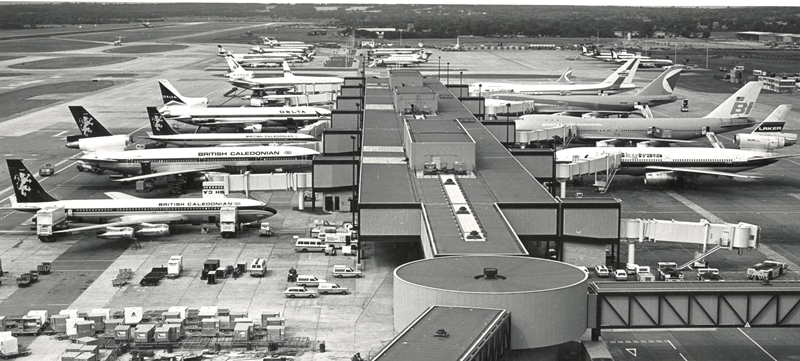
British Caledonian Aircraft at Gatwick Airport 1978
British Caledonian Aircraft at Gatwick Airport 1978 (Image Credit: Gatwick Airport)

This article was published in 2019 in a series on the history of British Airways and its predecessors Imperial Airways, BOAC and BEA. You can browse all 100 stories in number order, by theme or by decade.

Many have been updated since first published.

British Caledonian Airways, also known as BCAL, was formed in 1971 after the Edwards Committee in 1969 recommended the establishment of a “second force” independent airline to compete against the soon to be merged BEA/BOAC.

The airline was created through the merger of British United Airlines and Caledonian Airways and its hub was based at Gatwick. To give it a head start, the Government transferred route authorities to Central and West Africa and South America from BOAC to BCAL.

British Caledonian, London Gatwick - Caracas, 26 October 1976
British Caledonian, London Gatwick – Caracas, 26 October 1976

“We never forget you have a choice.”

British Caledonian sold itself on the basis that as an independent airline it had to work much harder to win customer loyalty.

"We never forget you have a choice" British Caledonian, 1977
“We never forget you have a choice” British Caledonian, 1977
"All airlines need friends in high places. At British Caledonian, they're called passengers" October 1982
“All airlines need friends in high places. At British Caledonian, they’re called passengers” October 1982

This was a time of significant Government intervention and route authorities were allocated by the Government between BA and BCAL.

BA insisted it needed the freedom to compete against international airlines and should not be impeded by losing routes. BCAL fought a very public campaign that further route authorities should be transferred from BA to BCAL. Not only that, BA should transfer its regional operations to other airlines, leave Gatwick to BCAL and operate exclusively from Heathrow.

Continue reading “BA100: 58. “We Never Forget You Have A Choice””

BA100: 59. “Where Is Everybody?”

100 Years Of British Airways: “Where Is Everybody?” asks BA in 1994.

London Air Travel » Page 58

This article was published in 2019 in a series on the history of British Airways and its predecessors Imperial Airways, BOAC and BEA. You can browse all 100 stories in number order, by theme or by decade.

Many have been updated since first published.

Airlines commonly advertise promotional offers with enticing images of the destinations on offer and the associated prices in a large typeface. 

This BA advert from 1994 doesn’t do that. Instead, the viewer is presented with a near post-apocalyptic vision. A man wakes up to find an empty home, no TV or radio services working, no rail services operating and empty streets as the entire city of London is deserted.

On first view, it is only at the end of the advert does the viewer have any clue as to what it is for (if you watch it back you’ll hear the sound of an aircraft taking off at around 11 seconds in).

To present the viewer with such an uncertain vision was a brave way of conveying the promotion that could otherwise have been done in a very ordinary and unremarkable way.

As well as a creative success, the campaign was considered a commercial success with an immediate increase in bookings as well as raising long term brand awareness.

You can continue reading our 100 part series on the history of British Airways and its predecessor airlines Imperial Airways, BOAC and BEA in numerical order, by theme or by decade.

If you would like to receive all future articles published by London Air Travel directly by e-mail, then enter your e-mail address below:

© Copyright London Air Travel 2019

BA100: 60. Project Lauren

100 Years Of British Airways: “OpenSkies” the now defunct European airline born out of the EU-US Open Skies treaty of 2007.

London Air Travel » Page 58

BA OpenSkies Logo
BA OpenSkies Logo (Image Credit: BA European Ltd)

This article was published in 2019 in a series on the history of British Airways and its predecessors Imperial Airways, BOAC and BEA. You can browse all 100 stories in number order, by theme or by decade.

Many have been updated since first published.

“Project Lauren” was born out of the Open Skies treaty of 2007 which liberalised the EU-US transatlantic market.

Hitherto, the operation of transatlantic routes was heavily restricted. Open Skies gave EU and US airlines the freedom to operate routes anywhere between the EU and the US.

BA took advantage by launching a new subsidiary OpenSkies. The company had its own CEO, Dale Moss, a former BA Executive who returned to the group.

This was not BA’s first foray into owning airlines based in mainland Europe – it had previously held unsuccessful investments in Air Liberte and Deutsche BA. Undetered, Open Skies started with grand ambitions. The plan was to provide with the airline with a large number of reconfigured Boeing 757s from BA. Its launch was controversial and provoked industrial relations tensions with BA pilots who objected to the establishment of a new airline outside of their collective bargaining agreements.

BA OpenSkies Boeing 757 Aircraft
BA OpenSkies Boeing 757 Aircraft (Image Credit: BA European Ltd)

On launch, OpenSkies was clearly aimed at the US market, possibly because it knew that local French loyalty to Air France would be hard to crack. Its long-haul business class was branded “Biz Bed”. This was effectively a reupholstered version of BA’s first Club World flat bed, and “Prem” (also briefly called “Biz Seat”) for premium economy and “Eco” for economy.

The branding and service at the time of launch was quite distinct from BA and it borrowed very much from “boutique” premium airlines of the era such as Silverjet and eos. The intention was give the feel of a small airline, with just 82 passengers on board each flight, but with the backup and support of its parent, such as the Executive Club frequent flyer programme.

BA OpenSkies Biz, Prem, Eco Cabins
BA OpenSkies Biz, Prem, Eco Cabins (Image Credit: BA European Ltd)

The airline launched with Paris to New York JFK in June 2008. Whilst it was well received by passengers, later route launches between Amsterdam and New York and Paris and Washington were not successful. In early 2009, BA decided to sell what remained of its Boeing 757 fleet rather than transfer them to OpenSkies.

At launch, OpenSkies was the only significant means of expansion for BA. It had withdrawn all non-London flights from UK regional airports and significantly downsized at London Gatwick. With no imminent prospect of a third runway, there was no scope for growth at Heathrow.

However, BA soon turned its attentions elsewhere. In early 2011, BA merged with Iberia. It finally, on its third attempt, secured a long sought after joint-venture with American Airlines. The acquisition of bmi in 2012 also enabled substantial growth at Heathrow, much of which has been on transatlantic routes.

OpenSkies was left in limbo for some time with no evident plan to upgrade its fleet and in-flight product which, baring the addition of a BA Boeing 767, had remained the same since launch.

In 2018, BA finally decided to plug the plug. After suspending Paris Orly – New York JFK in March 2018, the last flights between Paris Orly and Newark operated on Sunday 2 September 2018.

You can continue reading our 100 part series on the history of British Airways and its predecessor airlines Imperial Airways, BOAC and BEA in numerical order, by theme or by decade.

If you would like to receive all future articles published by London Air Travel directly by e-mail, then enter your e-mail address below:

© Copyright London Air Travel 2019

BA100: 61. British Airways & Australia

100 Years Of British Airways: How Imperial Airways and BOAC in co-operation with Qantas pioneered new services from the UK to Australia.

London Air Travel » Page 58

Imperial Airways / Qantas Empire Airways Poster
Imperial Airways / Qantas Empire Airways Poster (Image Credit: Qantas)

This article was published in 2019 in a series on the history of British Airways and its predecessors Imperial Airways, BOAC and BEA. You can browse all 100 stories in number order, by theme or by decade.

Many have been updated since first published.

If there’s one region of the world that illustrates both the progress of aviation in the past 100 years and the changing dynamics and balance of power, it’s Australia.

The Kangaroo Route

Imperial Airways and Qantas Airways first began to co-operate on UK – Australia services in 1934.

On 8 December 1934, the first UK to Australia mail service began operated by Imperial Airways (from Croydon to Karachi), Indian Trans-Continental (Karachi to Singapore) and Qantas Empire Airways (Singapore to Brisbane).

The event was marked by a special ceremony at Croydon presided over by Lord Londonderry, Secretary of State for Air. Included in the two tons of letters were three addressed by the King, the Queen, and the Prince of Wales to the Duke of Gloucester at Auckland.

Imperial Airways Air Mail Services, December 1934

The next year, on 13 April 1935, the first passenger service operated from London to Brisbane by Imperial Airways and Qantas Empire Airways. It initially operated weekly and the trip took 12 and a half days. It would become officially known as the Kangaroo Route.

Imperial Airways Services To Australia, May 1936

The Flying Boats

On 26 June 1938, Imperial Airways introduced flying boat services from Southampton to Australia.

Passengers would depart from the Imperial Airways Terminal in Victoria to catch a train to Southampton.

Configuration of Imperial Airways Flying Boats.
Imperial Airways Flying Boats

Imperial Airways’ had a fleet of 28 flying boats. Weighing 18 tonnes, these could accommodate up to 24 passengers and 5 crew. These were dubbed “veritable flying hotels” promising restaurant meals in spacious saloons with a promenade deck and separate smoking cabin. 

Passengers would sit in “the most luxurious chair in the world” which could move from an upright to reclined position at the touch of a lever.

Imperial Airways Flying Boats, May 1939

BOAC Post Second World War

BOAC services to Australia were terminated during the Second World War.

After the war time restrictions on flying were lifted, BOAC and Qantas began a flying boat service from Southampton to Australia, with the trip taking 5 and a half days. The flying boats were withdrawn from BOAC in 1949.

London airport, now Heathrow, opened to passenger flights on 31 May 1946. The first passenger flight to arrive at the airport a BOAC flight service from Sydney. The Lancaster aircraft took 63 and 1/4 hours to fly from Sydney, landing 2 hours ahead of schedule. BOAC’s three times weekly “express” service to Sydney was the first route the airline transferred to London airport, having previously operated from Hurn (also known as Bournemouth International) airport.

In 1947, Qantas began flying to London in its own right with the Lockheed Constellation aircraft.

Throughout the 1950s, a number of new aircraft types were introduced on the route.

On 9 May 1955, BOAC introduced a tourist class service from Heathrow with Lockheed Constellation aircraft.

British Overseas Airways Corporation crew pictured in front of a Constellation aircraft for BOAC's 1000th round trip from London to Sydney.
BOAC Constellation Aircraft London – Sydney (Image Credit: British Airways)

In March 1957, BOAC introduced Bristol Britannia aircraft which cut the journey time by 30 hours.

Joint BOAC/Qantas De Havilland Comet 4 services to Sydney would follow on 1 November 1959, operating five times weekly.

Picture of BOAC De Havilland DH106 Comet 4 Aircraft flying above Sydney Harbour Bridge, Australia.
BOAC De Havilland DH106 Comet 4 Aircraft, Sydney (Image Credit: British Airways)

It was in this year that BOAC and Qantas celebrated 25 years of partnership on this route.

Qantas & BOAC Kangaroo Route 25th anniversary, 10 December 1959

The Jet Age: London To Sydney In 33 Hours

The biggest advances came in the 1960s with the arrival of the VC10 and Boeing 707 aircraft.

Qantas began operating Boeing 707 jets from London via San Francisco in 1959.

BOAC Australia via New York, San Francisco, Honolulu and Fiji Advertisement 1967

In 1967, BOAC introduced its own Pacific route to Australia via New York, San Francisco, Honolulu, and Fiji. The trip took 33 hours.

The inaugural flight was filmed, and a video and transcript is below:

Continue reading “BA100: 61. British Airways & Australia”

BA100: 62. Trident Over Europe

100 Years Of British Airways: The Trident aircraft at British European Airways.

London Air Travel » Page 58

BEA Trident Aircraft Advertisement 1964

This article was published in 2019 in a series on the history of British Airways and its predecessors Imperial Airways, BOAC and BEA. You can browse all 100 stories in number order, by theme or by decade.

Many have been updated since first published.

In 1962, British European Airways took delivery first Hawker Siddeley Trident aircraft.

The three-engined aircraft was developed in response to a demand from BEA for a jet engined aircraft capable of carrying more than 100 passengers on short & medium-haul routes.

The first passenger flight, operated with aircraft G-ARPG, took place on 11 March 1964 when it replaced a Comet 4B aircraft on the London – Copenhagen route. It then entered a regular scheduled service on 1 April 1964 from London to Zurich and Nice.

A chief requirement when ordering the Trident aircraft was the ability to land in poor visibility.

In June 1965, a BEA Trident aircraft operating flight BE343 completed the world’s first fully automatic landing of a commercial passenger aircraft on arrival at Heathrow from Paris Le Bourget. A year later, a Trident aircraft completed its first automatic landing in fog at Heathrow.

BEA Trident Aircraft Advertisement 1966
BEA Trident Aircraft Advertisement May 1967

The aircraft were not without their short-comings, particularly regarding noise and range. However, partly due to political pressure – aircraft orders were at the time subject to Government approval – BEA continued to order further Trident model aircraft, taking delivery of the Trident Two and Trident Three. This took the BEA fleet up to 70 aircraft.

Continue reading “BA100: 62. Trident Over Europe”

BA100: 63. 1989, “The Imperial Phase”

100 Years Of British Airways: An advertising campaign from 1989 highlights BA’s ambition to become a major force in global aviation.

London Air Travel » Page 58

British Airways Advertisements, circa 1989

This article was published in 2019 in a series on the history of British Airways and its predecessors Imperial Airways, BOAC and BEA. You can browse all 100 stories in number order, by theme or by decade.

Many have been updated since first published.

If you were to identify one phase in BA’s history when the airline was at its most confident and ambitious, it’s probably around 1989.

The airline was in no doubt that it had the potential, through its own operations, franchises and interests in other airlines, to become a major player in global aviation. Speaking in 1989, former CEO Colin Marshall set out BA’s ambition: “There has never been a global airline, in the truest sense.”

As you can see from this global advertising campaign from 1989 that also ran in the early 1990s, BA was not shy in blowing its own trumpet in all cabins.

"Our Service Is Why We're So Frequently Chosen" British Airways Press Advert 1989
“The Best Things In Flight Are Free” British Airways Press Advert 1989 (Image Credit: British Airways)

“Fine wines. Premium brands at the bar. Feature films. And possibly the most gracious, attentive service on Earth – now available at 35,000 feet. Economy class in a class of its own ..compliments of British Airways.”

"Our Service Is Why We're So Frequently Chosen"
“Our Service Is Why We’re So Frequently Chosen” British Airways Press Advert 1989 (Image Credit: British Airways)

“When it comes to awards, British Airways has won more than its fair share: over 130 top honours in the past five years alone. And every one can be attributed to superior service. Whether it’s complimentary cocktails in Economy Class, fine dining on Royal Doulton china in Club Class, or the time-saving advantages of Concorde – no airline is more dedicated to the concept of service. British Airways meets the most exacting standards. Because far more important than winning awards, is winning you over.”

Continue reading “BA100: 63. 1989, “The Imperial Phase””

BA100: 64. London City Airport

100 Years Of British Airways: How BA went from next-to-nothing to Number 1 at London City airport.

London Air Travel » Page 58

BA CityFlyer Embraer at London City Airport

This article was published in 2019 in a series on the history of British Airways and its predecessors Imperial Airways, BOAC and BEA. You can browse all 100 stories in number order, by theme or by decade.

Many have been updated since first published.

For much of its 30+ year history London City airport was one of London’s best kept secrets.

Passengers at London Heathrow would have to grapple with poorly maintained and ageing terminals with little resilience to operational disruption. They were caught between airlines and the airport, whose relationship could at best be described as dysfunctional. Those in the know, however, headed east to the Royal Docks and London City airport.

Here’s some early footage of the airport in 1988 from Thames TV:

BA’s start there was fairly inauspicious. It’s CityJet that can take credit for building the airport’s presence. The first BA liveried flight from London City launched on 5 November 1999 when BA’s franchise partner British Regional Airlines began a three times daily service to Sheffield.

The first BA operated route launched in April 2003 to Glasgow, operated by a subsidiary British Airways CitiExpress, using a 110 seat RJ100 jet aircraft. Paris and Frankfurt would soon follow.

The real turning point came after BA had jettisoned what was left of its regional operations (earning itself the moniker “London Airways”) and turned its attention properly to London City.

What is now BA CityFlyer took delivery of its first Embraer aircraft in 2009, replacing much less efficient Avro jets.  BA now has a fleet of 6 Embraer E-170 and 18 Embraer E-190 aircraft based at London City. 2009 was also the year BA launched what remains the only transatlantic route from London City, to New York JFK.

British Airways At London City Airport (Image Credit: British Airways)

BA has over time built a respectable portfolio of short-haul routes. These are primarily business routes such as Edinburgh and Zurich, but also leisure routes such as Ibiza, Mykonos and Skiathos. Not all have been successful. Some have been suspended such as Copenhagen, Hamburg, Stockholm and, inexplicably, Madrid.

BA Embraer E170 London City Airport
BA Embraer E170 London City Airport (Image Credit: British Airways)
Continue reading “BA100: 64. London City Airport”

BA100: 65. “The Magic Of Flying”

100 Years Of British Airways: “Look Up”, an interactive billboard that would identify British Airways aircraft flying overhead.

London Air Travel » Page 58

This article was published in 2019 in a series on the history of British Airways and its predecessors Imperial Airways, BOAC and BEA. You can browse all 100 stories in number order, by theme or by decade.

Many have been updated since first published.

“Look Up” was a campaign developed by the interactive agency OgilvyOne for British Airways in 2013.

Interactive billboards in Chiswick and Piccadilly Circus would respond as a BA aircraft flew over it. OgilvyOne had installed antennae on nearby buildings which could identify overflying aircraft. Using custom-made software it would identify which of those aircraft were operated by BA.

A child would then point to the aircraft in the sky and the billboard would display its actual flight number and origin, highlighting the breadth of destinations served by BA.

As well as generating a significant number of visits to the BA website and impressions on social media, the campaign won multiple industry awards.

Continue reading “BA100: 65. “The Magic Of Flying””