One of the many things that are often lacking at airports in North America is a direct rail link from the airport to downtown.
Toronto is one city to gain such a link with the launch of the Union Pearson Express on Saturday 6 June 2015.
The new service will link Terminal 1 of Toronto’s main international airport, Toronto Pearson, with its main downtown railway station (Union Station), every 15 minutes with a journey time of 25 minutes on an elevated rail track. A return fare for an adult is CAD$53 (roughly £28).
There has been much interest following an announcement by the US Department for Homeland Security that it is exploring adding US pre-clearance facilities at 10 new airports worldwide.
These airports include London Heathrow and Manchester airport.
Put simply, the benefit of pre-clearance is that passengers clear US customs and immigration at a dedicated facility before boarding the aircraft.
On arrival in the US, the flight is treated in the same way as a domestic flight would and passengers can disembark the aircraft and immediately make their way out of the airport, with no further checks.
Anyone who has experienced immigration queues at the likes of New York JFK and Miami airports can testify to the benefits for passengers.
So will pre-clearance come to London Heathrow?
We hope so. However, there are some challenges.
Currently, transatlantic flights depart from four different terminals (Terminal 2 for United, Terminal 3 for American Airlines, Delta and Virgin Altantic, Terminal 4 for Delta, and Terminal 5 for British Airways).
It would not be feasible (nor desired on the part of the airlines) for all transatlantic flights to depart from one terminal, so each terminal would require its own pre-clearance facilities.
Any attempt to limit pre-clearance facilities to one terminal at London Heathrow is likely to be strongly resisted by those airlines whose passengers would not benefit from pre-clearance.
There is also the amount of available space for pre-clearance facilities. The transatlantic market is by far Heathrow’s biggest long-haul market. There are nearly 30 flights a day from London Heathrow to New York alone. Any facility will have to be of a considerable size to be worthwhile for passengers and compatible with efficient airport operations.
Heathrow airport also receives considerable income from letting terminal space to retailers and is likely to want to be compensated for any loss of income as a result of retail space being sacrificed to make way for pre-clearance facilities. Any attempt by Heathrow airport to be compensated through higher charges to airlines is likely to be strongly resisted by them.
So, many challenges and given the amount of work involved, pre-clearance (if it happens) is likely to be many years away.
Full details of the bid can be viewed in the offer document. A more easily digestable summary of IAG’s bid for Aer Lingus can be viewed in this IAG presentation.
IAG is due to hold a conference call for analysts tomorrow (Wednesday) morning. The deal is also far from done yet as Ryanair (which holds 30% of the shares in Aer Lingus) has yet to show its hand. The transaction will also be subject to regulatory approval.
This follows the announcement ny Heathrow Airport last month of a route development fund to support up to nine new UK domestic routes.
The rationale for this is that the number of UK domestic destinations from London Heathrow has fallen substantially over the past 25 years and does not compare favourably to rival hubs such as Amsterdam. So Heathrow wishes to encourage many more UK domestic routes.
Flybe is to suspend its London City – Dublin route from 31 May 2015, a little over six months after Flybe opened a base at the airport.
Passengers have been offered either a refund or an alternative flight on Flybe. The London City – Dublin route is served by CityJet and British Airways and the amount of capacity on the route is a likely factor behind Flybe’s decision.
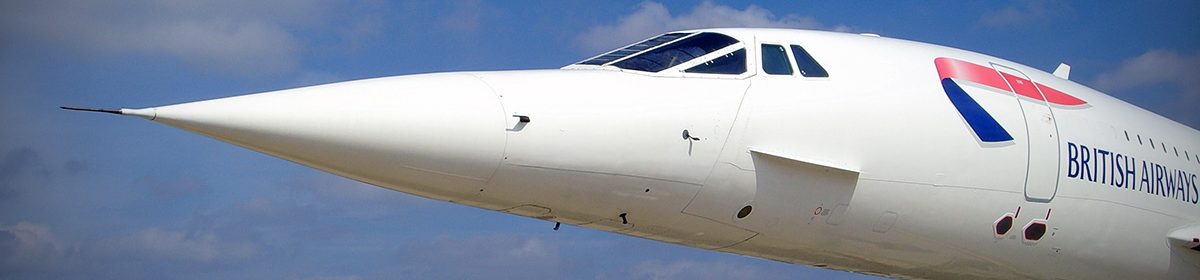
British Airways Concorde
We recently browsed the archives of BBC Radio 4’s long running series “Desert Island Discs” and found two recordings from over 20 years ago, featuring two giants of aviation.
The first is Lord King, the former Chairman of British Airways who, together with Colin Marshall, oversaw the transition of BA from a nationalised industry to the “World’s Favourite Airline”. The second is Sir Richard Branson, founder of Virgin Atlantic.
The interview with Lord King was first broadcast on 19 April 1991. The interview with Sir Richard Branson was first broadcast 9 June 1989. Both were interviewed by Sue Lawley.
Whilst the interview Lord King covers much of his time at British Airways, the interview with Sir Richard Branson barely touches on Virgin Atlantic – the main focus being Virgin Records which at the time was owned by Virgin. At the time Virgin Atlantic was just five years’ old. Interestingly, the relationship between the two airlines, which was to later sour significantly, isn’t mentioned in either interview.
The contrasting styles of Lord King and Sir Richard Branson are very much evident in the interviews.
That said, whilst Lord King does come across as a little cold at first he does warm up later into the interview. Furthermore, whilst Lord King’s style is seen as very much from a different era of business, so much so that Financial Times journalist Lucy Kellaway once wrote of his “bombastic rudeness” (legend has it that Lord King personally ordered the removal of BA advertising from the Financial Times after he took exception to a profile of him written by the paper), it is clear he has a genuine passion for business.
Furthermore, there is little Lord King says in the interview that many current aviation CEOs of today (Willie Walsh of International Airlines Group or Richard Anderson of Delta) would disagree with, particularly the references to the need for rational decision making and that sometimes painful decisions have to be made in the long term interests of the company.
Lord King also complains about government regulation and the barriers to true consolidation in the industry – two issues which are very much alive today.
As far as music choices go, neither interviews yield little surprises. The Flower Duet from Lakmé, famous for its use in many BA ads, features in Lord King’s choices. Many famous tracks from the Virgin Records back catalogue feature in Sir Richard Branson’s choices.
You can listen to the Lord King interview here and the Sir Richard Branson here.
Sadly, there was one other programme we would have loved to have covered here. That is an interview with the late Alan Whicker from 1967 but, alas, there is no audio online.
The Financial Times today reports that the board of Ryanair has given approval for the airline to launch transatlantic flights. The story has been picked up by Fortune.
This has been an oft repeated ambition of Ryanair, with Michael O’Leary notoriously promising “beds and blowjobs” for premium passengers.
Now it seems that Ryanair wants to follow in the footsteps of Norwegian and Lufthana’s Eurowings and launch low cost long-haul flights.
But what are its plans exactly?
Update 19 March: Ryanair has now confirmed, this time through an announcement to the stock exchange that it has no intention to launch a transatlantic airline.
KLM have released a short series of “Cockpit Tales” videos showing the work its pilots undertake on a day to day basis to ensure flights operate safely and according to plan.
Filmed using “fixed rig” cameras in the cockpit of KLM aircraft, the first video “Autopilot in Action” shows Captain van Dorst planning a flight from Amsterdam to London Heathrow, how the flight is programmed using flight management software and the use of autopilot, and communications with Air Traffic Control from takeoff through to landing.
In the second video, “Highways In The Sky”, Captain de Vries on a flight from Amsterdam to New York JFK airport shows how the airline plans a flight across the atlantic ocean, where for a large part of the journey the crew and aircraft will have no radar communication with Air Traffic Control.
Finally in “Big plane, short runway”, at just 2,300 metres, Princess Juliana International Airport on the island of Saint Martin has one of the most challenging runways in the world. Captain ten Velde shows how KLM ensures it lands a Boeing 747 jumbo safely on the island.
We like these videos. There’s a huge amount that gets taken for granted in aviation and anything that increases understanding of aviation should be welcomed.
British Airways today confirmed that is to move its entire London Gatwick operation from the North terminal to the South terminal at an as yet unspecified date in November 2016.
The purpose of the move is to allow easyJet to consolidate its London Gatwick operation in the North terminal.
BA will benefit from an upgraded check-in area and a new lounge facility for eligible passengers. BA has confirmed that a new lounge for eligible customers will be constructed in the North terminal.
As BA’s London Gatwick operation involves approximately 60 departures a day, we expect the move will take place in phases.
Perhaps what is more significant are easyJet’s ambitions once it consolidates operations in one terminal.
easyJet currently has 45% of departure and arrival slots at Gatwick, compared to just 16% for BA. Ten years ago, BA had 30% of departure and arrival slots, and easyJet had 13%.
easyJet has made a number of moves in recent years to move it closer to the traditional full service carrier model, such as offering allocated seating and fast track ground facilities.
The one thing easyJet doesn’t do is interline with other airlines (this is where an airline will transfer your bag to another airline’s flight on a connecting ticket). Nor does it codeshare with other airlines. Nor does it offer connections.
Currently, a passenger wishing to fly from say, Edinburgh to Tel Aviv via Gatwick would have to “self-connect” and buy two separate tickets (and hope for the best if things go wrong!).
If easyJet was to move to a traditional “hub” model offering connections and codeshares with other airlines, this could radically change its position in the market and that of London Gatwick. There is certainly precedent for a low cost carrier to do this, as Vueling does at its hub in Barcelona.
This would of course add cost and complexity to easyJet’s operation (which it may be keen to avoid) but connecting traffic could support many more routes from Gatwick.
One other point of note is that Aer Lingus (currently a takeover target for BA’s parent company International Airlines Group) also operates in the South terminal and a consolidation of operations may allow for greater co-operation between BA and Aer Lingus at Gatwick.